About Course
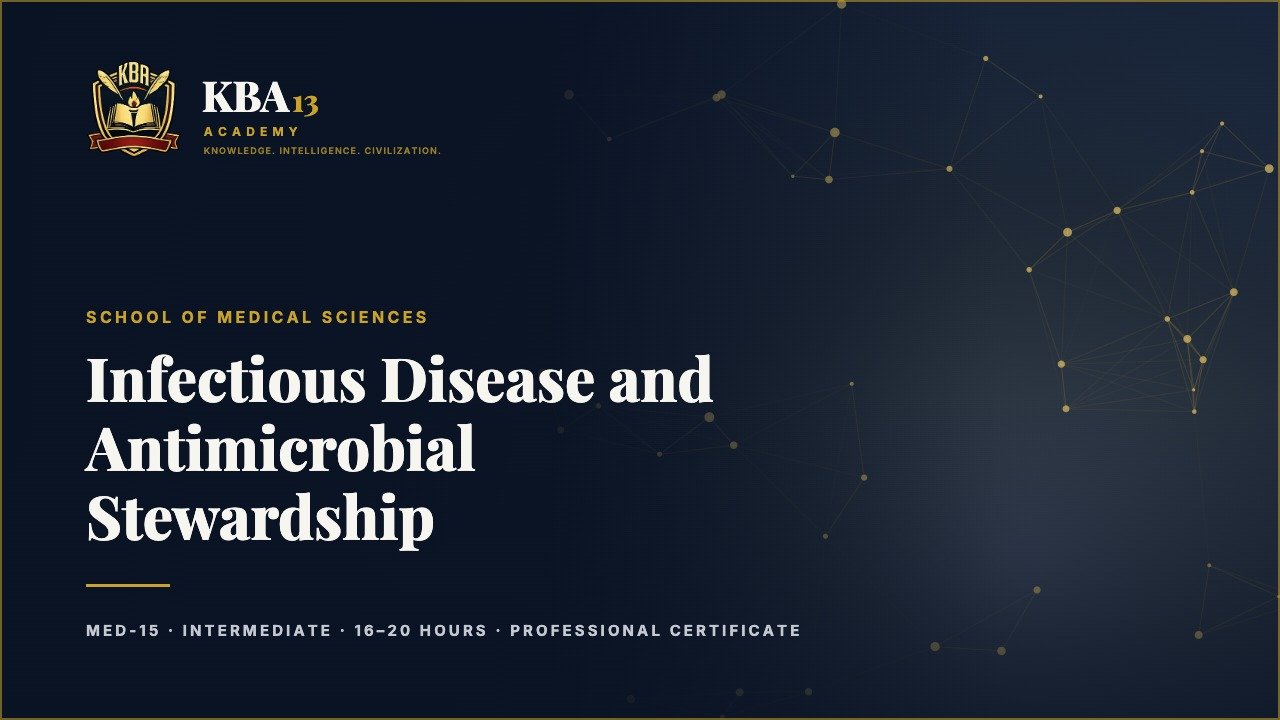
Course Code: MED-15
School: School of Medical Sciences
Field: Infectious Disease and Antimicrobial Stewardship
Level: Intermediate
Estimated duration: 16–20 learning hours
Access: Preview Edition — public curriculum preview
Course purpose
Explores pathogen behavior, antimicrobial selection, resistance tracking, and prevention.
MED-15 is an independent, non-degree medical-sciences course offered by KBA13 Academy. It builds conceptual understanding and evidence literacy in infectious disease and antimicrobial stewardship. It does not train learners to diagnose or treat patients, does not replace accredited clinical education or supervision, and does not provide individualized medical advice. Concepts are examined critically rather than presented as universally settled standards of care.
Learning outcomes
By completing the course, learners will be able to:
- Explain the core concepts, terminology, and scientific basis of infectious disease and antimicrobial stewardship.
- Relate structure, mechanism, and function across molecular, tissue, and systems levels where relevant.
- Interpret representative data, findings, or scenarios using disciplined, evidence-aware reasoning.
- Distinguish description, interpretation, empirical evidence, and normative judgment.
- Apply guidelines and primary literature critically, recognizing quality and limits of evidence.
- Analyze structured, non-clinical cases without diagnosing or prescribing for real individuals.
- Communicate reasoning clearly, with explicit assumptions, uncertainties, and safeguarding boundaries.
- Produce a source-aware capstone analysis that states its scope and limitations.
Course structure
The course is organized into eight modules that move from foundations to applied, evidence-based reasoning.
Module 1 — Foundations and Orientation Establishes the scope, vocabulary, and evidence standards of infectious disease and antimicrobial stewardship, and positions the field within the wider landscape of medical sciences. Module 2 — Microbial life cycles and transmission routes Develops working knowledge of microbial life cycles and transmission routes, combining structured theory with guided interpretation, worked examples, and applied reasoning tasks. Module 3 — Antibiotic class matching and dosing logic Develops working knowledge of antibiotic class matching and dosing logic, combining structured theory with guided interpretation, worked examples, and applied reasoning tasks. Module 4 — Resistance surveillance and containment Develops working knowledge of resistance surveillance and containment, combining structured theory with guided interpretation, worked examples, and applied reasoning tasks. Module 5 — Hospital infection prevention protocols Develops working knowledge of hospital infection prevention protocols, combining structured theory with guided interpretation, worked examples, and applied reasoning tasks. Module 6 — Community prevention communication plans Develops working knowledge of community prevention communication plans, combining structured theory with guided interpretation, worked examples, and applied reasoning tasks. Module 7 — Evidence, Guidelines, and Critical Appraisal Trains learners to read primary literature and guidelines critically, weigh quality of evidence, and distinguish established findings from provisional or contested claims. Module 8 — Applied Case Analysis and Capstone Integrates the course through a structured, non-clinical case analysis and a capstone task that demonstrates reasoning, source traceability, and awareness of limits.
Learning method
Each module combines conceptual orientation, clarification of key terms, guided interpretation, a worked example, critical questions, and an applied task. Learners keep a study notebook that separates documented evidence, an author’s claim, the learner’s interpretation, and open questions requiring verification, reducing the risk that compelling ideas are mistaken for established findings.
Assessment
The assessment portfolio includes concept checks, a structured interpretation task, an evidence-appraisal exercise, and a final non-clinical case analysis. Rubrics emphasize accuracy, source traceability, conceptual precision, recognition of alternative interpretations, ethical awareness, and the ability to state limitations.
Responsible use of knowledge and AI
This course supports understanding, not practice. Learners must not enter confidential health information into public AI services, must verify AI-assisted claims and citations, and must disclose material AI assistance affecting submitted work. Knowledge from this course must not be used to self-diagnose, self-treat, or advise others clinically.
Source and safety note
The course draws on established textbooks, peer-reviewed literature, and reputable clinical and public-health guidance. It provides general educational content only and does not offer diagnosis, therapy, crisis intervention, medical advice, clinical supervision, or professional licensing. Anyone needing medical assistance should contact an appropriately qualified professional or emergency service.
Completion standard
Completion requires engagement with all eight modules, submission of the required portfolio, respect for privacy and source-integrity requirements, and successful completion of the final assessment when available. A successful learner should be able to explain the field accurately, reason from evidence, and recognize the point at which academic study must yield to professional standards, law, safeguarding, and accountable clinical judgment.
Course Content
Module 1 — Foundations and Orientation
-
1.1 Foundations and Orientation
Module 2 — Microbial life cycles and transmission routes
Module 3 — Antibiotic class matching and dosing logic
Module 4 — Resistance surveillance and containment
Module 5 — Hospital infection prevention protocols
Module 6 — Community prevention communication plans
Module 7 — Evidence, Guidelines, and Critical Appraisal
Module 8 — Applied Case Analysis and Capstone
Student Ratings & Reviews