School of Artificial Intelligence · Demokrasi, Generasi & Kecerdasan Buatan
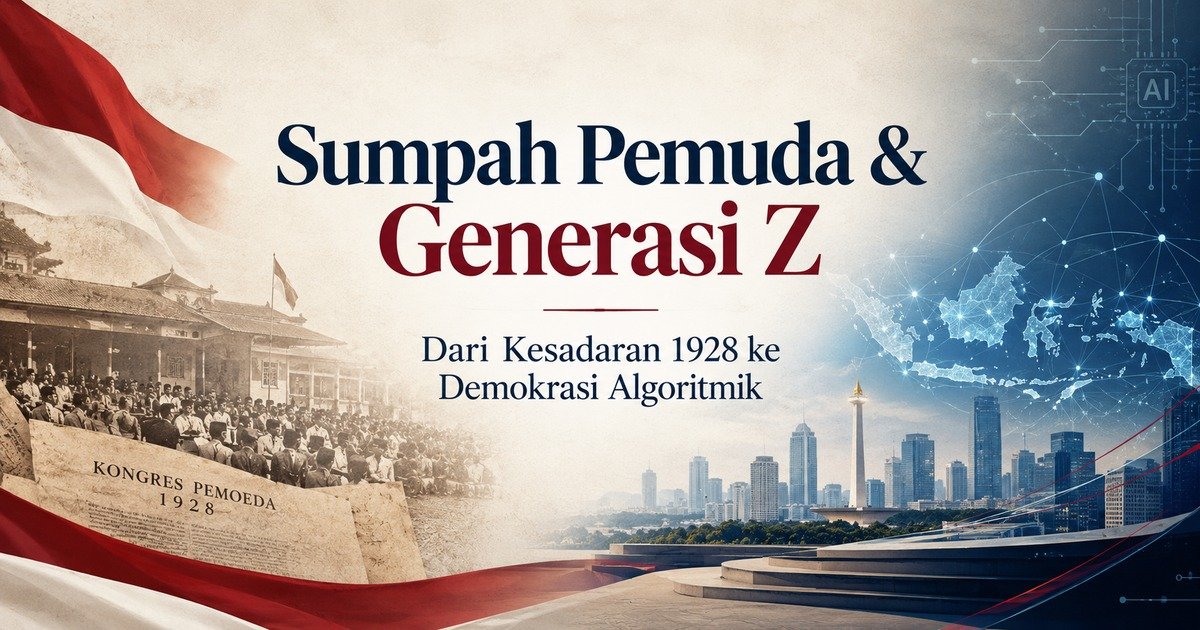
Sumpah Pemuda dan Generasi Z:Dari Kesadaran 1928 ke Demokrasi Algoritmik
Generasi Z Indonesia mampu menghentikan sebuah keputusan dalam hitungan hari, tetapi belum mampu mewarisi kekuasaan yang digoyangnya. Kertas kerja ini menempatkan jurang pewarisan itu dalam gelombang protes Gen Z global dan menimbang taruhannya ketika medium politik bergeser dari algoritme ke kecerdasan buatan generatif.
Abstrak
Kertas kerja ini menanyakan apakah kesadaran kebangsaan yang dirumuskan pada 1928 melalui kongres, pers, dan bahasa persatuan masih dapat direproduksi ketika medium pembentuk kesadaran berpindah ke sistem rekomendasi algoritmik dan kecerdasan buatan generatif. Dengan kerangka rezim medium kesadaran, unit generasi Mannheim, jurang pewarisan, dan kedaulatan medium, kajian ini menelusuri pola pemuda Indonesia dari 1945 hingga 2025 sebagai akselerator yang jarang mewarisi kekuasaan, lalu menguji pola itu pada data demografi, ketenagakerjaan, dan konsumsi berita Generasi Z serta pada rangkaian protes Agustus 2025 hingga Agustus 2026. Perbandingan dengan Sri Lanka, Bangladesh, Kenya, Nepal, dan Madagaskar menghasilkan tipologi empat jalur konversi gerakan generasional, sementara data V-Dem, International IDEA, Pew, dan Reuters Institute menempatkan Indonesia dalam kemunduran demokrasi global. Kajian ini membahas peralihan ke rezim sintetis, regulasi deepfake di Korea Selatan, Uni Eropa, dan Taiwan, serta rancangan peraturan presiden tentang kecerdasan buatan di Indonesia. Empat skenario hingga pertengahan 2030-an disajikan sebagai penilaian penulis, disertai indikator, rekomendasi bagi aktor nasional dan internasional, serta keterbatasan kajian.
Generasi Z telah mewarisi ritual Sumpah Pemuda dan kapasitas mobilisasinya, tetapi belum mewarisi metodenya; tanpa wahana kelembagaan sebelum Pemilu 2029, energinya lebih mungkin dipanen elite lama daripada memperbarui demokrasi.
- DataSensus 2020, DPT Pemilu 2024, NEET BPS, Reuters Institute DNR 2025, V-Dem 2026, International IDEA, Pew, serta pemberitaan protes 2019–2026 di Indonesia dan lima negara pembanding.
- KerangkaRezim medium kesadaran (cetak, siar, algoritmik, sintetis), unit generasi Mannheim, jurang pewarisan, kedaulatan medium, dan tipologi empat jalur konversi.
- ProyeksiEmpat skenario hingga pertengahan 2030-an (penilaian penulis): Regenerasi Terkooptasi 45%, Ledakan Tanpa Pewaris 25%, Demokrasi Algoritmik Terkelola 20%, Sumpah Pemuda Kedua 10%.
Kata kunci
- Sumpah Pemuda 1928
- Generasi Z
- Generasi Alpha
- demokrasi Indonesia
- jurang pewarisan
- rezim sintetis
- kecerdasan buatan
- Pemilu 2029
Ringkasan Eksekutif: Pertanyaan, Jawaban, dan Taruhannya
Kajian ini bertanya apakah kesadaran kebangsaan, yang pada 1928 dirumuskan lewat kongres, notulen, surat kabar, dan sebuah bahasa persatuan, masih dapat direproduksi ketika medium pembentuk kesadaran telah berpindah ke sistem rekomendasi algoritmik dan, sebentar lagi, ke mesin percakapan berbasis kecerdasan buatan. Jawaban pokoknya tegas: Generasi Z Indonesia telah membuktikan kapasitas mobilisasi yang jauh melampaui generasi mana pun sebelumnya, tetapi belum membuktikan kapasitas untuk mengonversi mobilisasi itu menjadi program, organisasi, dan kepemimpinan yang bertahan. Jurang antara keduanya bukan kekhasan Indonesia. Dalam empat tahun terakhir, gerakan yang dipimpin anak muda menjatuhkan atau memaksa mundur pemerintahan di Sri Lanka, Bangladesh, Kenya, Nepal, dan Madagaskar, namun laporan Global State of Democracy edisi 2026 dari International IDEA mencatat bahwa menerjemahkan mobilisasi semacam itu menjadi reformasi kelembagaan yang langgeng tetap sulit dan hasilnya rapuh. Indonesia karena itu merupakan kasus uji bagi pertanyaan global: apakah sebuah negara dengan lebih dari 204 juta pemilih terdaftar dan kohort Gen Z sekitar 75 juta orang dapat memperbarui dirinya dari bawah ketika medium politiknya dikendalikan oleh platform dan, kian lama, oleh model bahasa.
Taruhannya melampaui batas nasional karena tiga alasan. Pertama, Democracy Report 2026 dari V-Dem Institute kini mengklasifikasikan Indonesia sebagai otokrasi elektoral dengan catatan berada di zona abu-abu, dan menempatkannya dalam episode otokratisasi sejak 2019; arah Indonesia ikut menentukan apakah Asia Timur dan Pasifik, tempat hanya 11 persen penduduk hidup dalam demokrasi menurut laporan yang sama, kehilangan salah satu jangkar demokratisnya. Kedua, Indonesia adalah salah satu pasar pengguna kecerdasan buatan terbesar di dunia: kepala ekonom OpenAI, sebagaimana dilaporkan The Jakarta Post melalui Asia News Network pada Juli 2025, menempatkannya di antara tiga negara teratas berdasarkan jumlah pengguna mingguan. Ketiga, Pemilu 2029 akan berlangsung setelah kewajiban transparansi konten sintetis Uni Eropa berlaku dan setelah Korea Selatan menguji larangan deepfake kampanye, sehingga pilihan regulasi Indonesia akan menjadi rujukan bagi demokrasi besar di Selatan Global. Kajian ini menyimpulkan, dengan keyakinan sedang, bahwa tanpa intervensi kelembagaan sebelum 2029, skenario paling mungkin adalah regenerasi yang terkooptasi, sedangkan skenario paling berbahaya adalah demokrasi algoritmik terkelola, dan keduanya lebih mungkin daripada pembaruan generasional yang sesungguhnya.
Kerangka Analitis dan Catatan Metode
Kajian ini memakai empat konsep yang didefinisikan secara ketat. Konsep pertama adalah rezim medium kesadaran, yakni susunan teknologi komunikasi dominan yang menentukan cara sebuah generasi menerima informasi, membentuk opini, dan membayangkan komunitas politiknya. Empat rezim dibedakan: rezim cetak, yang membentuk generasi pergerakan hingga pertengahan 1960-an; rezim siaran, yang didominasi televisi dan radio negara pada masa Orde Baru; rezim algoritmik, tempat linimasa yang dikurasi mesin menentukan apa yang terlihat; dan rezim sintetis, tempat mesin tidak lagi sekadar menyaring konten tetapi memproduksinya dan bercakap-cakap dengan warga. Konsep kedua dipinjam dari esai Karl Mannheim tahun 1928, The Problem of Generations, yang membedakan lokasi generasi (sekadar lahir pada kurun yang sama), generasi sebagai aktualitas (terlibat langsung dalam peristiwa besar), dan unit generasi (kelompok di dalamnya yang menafsirkan pengalaman bersama menjadi program). Konsep ketiga adalah jurang pewarisan, yaitu selisih antara kemampuan sebuah gerakan generasional memaksa perubahan dan kemampuannya menduduki serta mengubah lembaga sesudahnya. Konsep keempat adalah kedaulatan medium, yakni sejauh mana warga dan lembaga publik, bukan hanya korporasi platform atau aparat negara, ikut menentukan aturan main medium yang membentuk kesadaran politik.
Sebagai bahan ajar School of Artificial Intelligence, kerangka ini menjawab tiga pertanyaan inti bidang tersebut: bagaimana sistem kecerdasan buatan mengubah formasi opini publik, siapa yang harus mengatur medium itu dan dengan prinsip apa, dan bagaimana literasi kecerdasan buatan dapat menjadi literasi kewargaan. Basis buktinya terdiri atas data demografi dan ketenagakerjaan Badan Pusat Statistik yang diolah portal data, data pemilih Komisi Pemilihan Umum, indeks demokrasi V-Dem dan International IDEA, survei Pew Research Center dan Reuters Institute, pemberitaan nasional dan internasional hingga Oktober 2026, regulasi kecerdasan buatan di Uni Eropa, Korea Selatan, Taiwan, dan Indonesia, serta sejumlah analisis kebijakan dan artikel arsip surat kabar. Penilaian kunci diberi label keyakinan tinggi, sedang, atau rendah: keyakinan tinggi dipakai bila beberapa sumber independen sepakat, keyakinan sedang bila bukti kuat tetapi bergantung pada satu jenis sumber atau mengandung tafsir, dan keyakinan rendah bila penilaian bertumpu pada inferensi. Probabilitas skenario bukan hasil model statistik melainkan penilaian terstruktur, dan diperlakukan demikian di seluruh laporan.
1928 sebagai Tolok Ukur: Kesadaran yang Mendahului Negara
Kongres Pemuda II berlangsung di Batavia pada 27–28 Oktober 1928 dalam tiga sesi: di gedung Katholieke Jongelingenbond, di gedung Oost Java Bioscoop, dan akhirnya di rumah milik Sie Kong Lian di Jalan Kramat Raya 106, sebagaimana dirangkum dalam entri ensiklopedis tentang Sumpah Pemuda. Kongres diketuai Soegondo Djojopoespito dari PPPI dengan Mohammad Yamin sebagai sekretaris dan Amir Sjarifuddin sebagai bendahara, menurut rangkuman Good News from Indonesia, serta dihadiri antara lain Jong Java, Jong Sumatranen Bond, Jong Bataks Bond, Jong Islamieten Bond, Jong Celebes, Jong Ambon, dan Pemoeda Kaoem Betawi. Hampir semua organisasi itu dinamai menurut pulau, suku, atau agama; hasil kongres justru merumuskan identitas yang melampaui asal-usul tersebut tanpa menghapusnya. Sejarah perumusannya juga memperlihatkan bahwa kebangsaan dinegosiasikan, bukan diwarisi. Rancangan awal Yamin menyebut bahasa Melayu sebagai bahasa persatuan, sedangkan Mohammad Tabrani menolak dan menuntut nama “bahasa Indonesia” agar kata Indonesia hadir pula dalam butir ketiga; perselisihan itu tidak selesai di Kongres Pemuda I tahun 1926 dan baru diputuskan pada 1928. Pilihan untuk menjadikan bahasa pasar dan pers, bukan bahasa kelompok etnis terbesar, sebagai bahasa persatuan merupakan keputusan medium paling berpengaruh dalam sejarah politik Asia Tenggara modern.
Benedict Anderson, dalam Imagined Communities yang terbit pada 1983, menjelaskan mengapa keputusan semacam itu mungkin: kapitalisme cetak, perpaduan modal dan teknologi percetakan, memungkinkan orang yang tidak pernah bertemu membayangkan diri sebagai satu komunitas melalui surat kabar dan bahasa yang dibakukan. Para pemuda 1928 adalah anak kandung rezim cetak, yakni produk sekolah kolonial, pers pergerakan, dan organisasi yang hidup dari notulen dan majalah. Dari peristiwa itu kajian ini menurunkan tiga ciri yang dipakai sebagai tolok ukur sepanjang laporan. Kesadaran 1928 bersifat deliberatif, karena dibangun melalui pidato, perdebatan, dan perbedaan pendapat yang dicatat. Ia bersifat transidentitas, karena menambahkan identitas yang lebih luas di atas identitas asal. Ia bersifat proyektif, karena berorientasi pada negara yang belum ada, tujuh belas tahun sebelum proklamasi. Perlu dicatat bahwa para perumusnya adalah minoritas terdidik dalam masyarakat yang sebagian besar belum melek huruf; kekuatan mereka terletak pada kemampuan merumuskan kerangka yang kemudian diadopsi jutaan orang, bukan pada jumlah. Ukuran yang adil bagi Generasi Z karenanya bukan apakah seluruh kohortnya berpolitik, melainkan apakah ada unit generasi di dalamnya yang sedang merumuskan kerangka baru bagi republik.
Akselerator yang Jarang Mewarisi: Pola Generasional 1945–2025
Sejarah republik memperlihatkan pola yang berulang dengan konsistensi mencolok: pemuda mempercepat perubahan, tetapi kursi kekuasaan sesudahnya diduduki pihak lain. Pada dini hari 16 Agustus 1945, sekelompok pemuda yang dipimpin Sukarni membawa Sukarno dan Hatta ke Rengasdengklok untuk mendesak proklamasi segera dan menjauhkan keduanya dari pengaruh Jepang, sebagaimana diringkas entri tentang Peristiwa Rengasdengklok. Pada 1966, Kesatuan Aksi Mahasiswa Indonesia yang dibentuk Oktober 1965 mengumumkan Tritura pada 10 Januari 1966, dan kematian mahasiswa Arief Rahman Hakim setelah pengumuman kabinet baru pada akhir Februari mempercepat runtuhnya Demokrasi Terpimpin, tetapi transisi menuju Orde Baru berpuncak pada Supersemar 11 Maret 1966 yang menyerahkan kewenangan kepada Mayor Jenderal Soeharto, bukan kepada mahasiswa. Pada 15–16 Januari 1974, protes mahasiswa saat kunjungan Perdana Menteri Kakuei Tanaka berubah menjadi Peristiwa Malari dengan sebelas korban tewas, sekitar 770 orang ditangkap, dan dua belas penerbitan kehilangan izin terbit; jawabannya adalah represi yang lebih keras, bukan pembukaan politik. Pada 12 Mei 1998, empat mahasiswa Universitas Trisakti, yaitu Elang Mulia Lesmana, Heri Hertanto, Hafidin Royan, dan Hendriawan Sie, tewas ditembak, dan Soeharto mundur pada 21 Mei 1998 menurut catatan tentang penembakan Trisakti. Generasi 1998 memenangkan kebebasan, namun ekonomi politik yang dibongkar Jeffrey A. Winters dalam Dosa-Dosa Politik Orde Baru pada 1999, yakni jejaring kroni, utang, dan oligarki, sebagian besar bertahan dan beradaptasi dengan demokrasi elektoral.
Pola itu berlanjut di era digital. Pada 26 September 2019, dalam gelombang protes terhadap revisi Undang-Undang KPK dan rancangan KUHP, dua mahasiswa Universitas Haluoleo, Immawan Randi dan Muhammad Yusuf Kardawi, meninggal setelah aksi di DPRD Sulawesi Tenggara, dengan Randi tewas akibat peluru tajam menurut laporan Bisnis.com; revisi itu tetap berlaku. Pada Agustus 2024, gambar “Peringatan Darurat” bergambar Garuda biru menyebar setelah Badan Legislasi DPR berupaya menganulir Putusan Mahkamah Konstitusi Nomor 60/PUU-XXII/2024 tentang ambang pencalonan kepala daerah, dan Hukumonline melaporkan pada 23 Agustus 2024 bahwa pengesahan revisi itu batal. Kemenangan tersebut nyata, tetapi defensif: ia mempertahankan putusan pengadilan, bukan menciptakan jalur baru bagi kepemimpinan muda. Sebaliknya, jalur yang sungguh terbuka bagi pemimpin di bawah usia 40 tahun lahir dari Putusan MK Nomor 90/PUU-XXI/2023 yang dibacakan 16 Oktober 2023 dan dibaca publik luas sebagai karpet merah bagi putra presiden yang menjabat, bukan sebagai kemenangan generasi. Dengan kata lain, regenerasi usia terjadi melalui garis kekerabatan, sementara regenerasi gerakan berhenti di jalanan.
Tiga mekanisme menjelaskan mengapa jurang pewarisan begitu persisten, dan kajian ini menilainya dengan keyakinan tinggi karena konsisten di lintas periode. Mekanisme pertama adalah ketiadaan regenerasi kelembagaan dalam partai. Analisis Peta Konflik Elite Indonesia 2026–2035 (2026) mendiagnosis bahwa pergantian elite berlangsung lewat patronase, kompromi elite, dan krisis, sehingga elite lama tidak pernah sepenuhnya keluar dan elite baru tidak pernah sepenuhnya mengambil kendali. Mekanisme kedua adalah kooptasi: figur gerakan diserap menjadi staf khusus, komisaris, atau calon legislatif sebelum sempat membangun basis yang otonom, sebuah gejala yang sudah dikritik Miftah Thoha dalam harian Kompas pada 8 September 2014 lewat tulisan Menteri dan Partai Politik, yang menuntut agar jabatan publik diisi berdasarkan kompetensi dan integritas, bukan jatah partai. Mekanisme ketiga adalah warisan depolitisasi kampus sejak kebijakan normalisasi akhir 1970-an, yang kini berwujud orientasi berlebihan pada akreditasi, peringkat, dan kelulusan tepat waktu. Hasilnya adalah siklus yang dapat diramalkan: kemarahan, mobilisasi, kemenangan simbolik, lalu kekecewaan. Dalam bahasa Mannheim, sebagian besar gerakan sesudah 1928 berhenti sebagai generasi aktualitas dan jarang menjadi unit generasi.
Generasi Z dalam Angka dan Algoritma
Ukuran kohortnya tidak diragukan. Menurut data Sensus Penduduk 2020 yang dirangkum GoodStats dari BPS, Generasi Z, yaitu mereka yang lahir pada 1997–2012, berjumlah sekitar 74,93 juta jiwa atau 27,94 persen penduduk, sedikit di atas milenial dengan 69,38 juta jiwa atau 25,87 persen. Pada 2026 anggota tertuanya berusia 29 tahun dan termudanya 14 tahun. Dalam Daftar Pemilih Tetap Pemilu 2024 sebanyak 204.807.222 orang, KPU mencatat 46.800.161 pemilih Gen Z (22,85 persen) dan 68.822.389 pemilih milenial (33,6 persen), sebagaimana dilaporkan Bisnis.com pada 2 Juli 2023. Implikasinya sering salah dibaca: gabungan Gen Z dan milenial, sekitar 56 persen, sudah menjadi mayoritas mutlak pemilih sejak 2024, sehingga Pemilu 2029 bukan pemilu pertama dengan mayoritas muda. Kebaruan 2029 terletak di tempat lain, yakni masuknya pemilih kelahiran 2010–2012 yang tumbuh sepenuhnya di bawah rezim algoritmik dan menyentuh rezim sintetis sejak remaja. Fakta bahwa mayoritas muda sudah ada tanpa menghasilkan politik yang berorientasi pada kepentingan muda merupakan bukti terkuat bahwa masalahnya terletak pada konversi, bukan pada jumlah.
Kondisi material kohort ini memperlebar jurang itu. Data BPS yang dihimpun GoodStats menunjukkan proporsi pemuda usia 15–24 tahun yang tidak bekerja, tidak bersekolah, dan tidak mengikuti pelatihan (NEET) memang turun dari 24,28 persen pada 2020 menjadi 19,44 persen pada 2025, tetapi pada 2023 angkanya setara dengan 9,89 juta anak muda, dengan perempuan lebih banyak daripada laki-laki. Tingkat pengangguran terbuka nasional pada Agustus 2025 tercatat 4,85 persen atau 7,46 juta orang menurut rilis BPS yang diberitakan Bisnis.com. Kegelisahan itu menemukan bahasanya sendiri dalam tagar #KaburAjaDulu pada awal 2025, yang oleh dewan redaksi The Jakarta Post disejajarkan dengan gerakan “japa” di Afrika dan diperingatkan sebagai jalan menuju pengurasan talenta. Kekhawatiran ini bukan baru: Budi Santosa dalam harian Kompas pada 2 Mei 2014 lewat tulisan Dari “Brain Drain” ke “Brain Gain” sudah berargumen bahwa Tiongkok dan Korea Selatan berhasil memanggil pulang talentanya karena membangun daya tarik di dalam negeri, bukan karena melarang orang pergi. Perbedaannya, pada 2025 keinginan pergi diekspresikan secara kolektif dan politis di ruang algoritmik.
Medium itulah pembeda utama Gen Z. Data Reuters Institute Digital News Report 2025 yang dirangkum GoodStats menempatkan Indonesia di urutan keempat dunia dalam penggunaan TikTok untuk berita, dengan 34 persen responden, setelah Thailand, Malaysia, dan Kenya, jauh di atas rata-rata global 17 persen; laporan yang sama, menurut ringkasan What’s New in Publishing, mencatat bahwa 15 persen responden di bawah 25 tahun sudah memakai chatbot kecerdasan buatan untuk berita setiap minggu. Di ruang kelas, Global Student Survey 2025 dari Chegg menemukan 95 persen mahasiswa Indonesia berusia 18–21 tahun memakai kecerdasan buatan generatif dalam belajar, tertinggi di antara negara yang disurvei. Medium ini tidak sepenuhnya merusak: artikel Ketika Tradisi Bertemu Algoritma (2026) mencatat bagaimana seni dan busana tradisi menemukan audiens baru di halaman rekomendasi. Namun logika strukturalnya berlawanan dengan tiga ciri 1928. Linimasa memberi imbalan pada reaksi, bukan deliberasi; ia memecah publik menjadi gelembung, bukan menambahkan identitas bersama; dan ia hidup dalam masa kini yang terus diperbarui, bukan dalam proyeksi. Byung-Chul Han menyebut kondisi ini sebagai infokrasi, yakni krisis demokrasi akibat digitalisasi. Kajian ini menilai, dengan keyakinan sedang, bahwa rezim algoritmik memperkuat kapasitas mobilisasi Gen Z sekaligus melemahkan kapasitas deliberatifnya, dan bahwa kedua efek itu berasal dari mekanisme yang sama.
Agustus 2025 hingga Agustus 2026: Uji Lapangan Pertama
Rangkaian 2025 adalah uji lapangan pertama bagi tesis tersebut. Gelombang pertama dimulai pada 17 Februari 2025 ketika badan eksekutif mahasiswa menggelar aksi bertajuk Indonesia Gelap menentang pemangkasan anggaran, disusul gelombang Maret menentang revisi Undang-Undang TNI dan protes di Pati pada pertengahan Agustus terhadap kenaikan pajak bumi dan bangunan, sebagaimana dicatat kronik protes Indonesia 2025. Pada 25 Agustus, protes di depan DPR menentang tunjangan perumahan anggota dewan hingga Rp50 juta per bulan berujung bentrokan, dan pada malam 28 Agustus 2025 pengemudi ojek daring berusia 21 tahun, Affan Kurniawan, tewas dilindas kendaraan taktis Brimob di Pejompongan, menurut laporan CNA Indonesia. Simbol gerakan ini lahir dari budaya populer: sejak awal Agustus, bendera bajak laut dari serial animasi One Piece menyebar dan dijawab pejabat negara dengan peringatan pidana, sebagaimana dilaporkan Indoleft. Tuntutan gerakan dirumuskan dalam dokumen “17+8”: tujuh belas tuntutan jangka pendek bertenggat 5 September 2025 dan delapan agenda reformasi bertenggat 31 Agustus 2026, termasuk pembersihan DPR, reformasi partai, pengesahan RUU Perampasan Aset, dan reformasi kepolisian.
Episode ini memperlihatkan kekuatan sekaligus kerentanan rezim algoritmik. Analisis Pasca 25 Agustus 2025: Operasi Wacana, Influencer, dan Perang Informasi di Medsos (2025) mendokumentasikan lonjakan tagar #BubarkanDPR yang bergerak dari satu platform ke platform lain dalam rentang sepekan, indikasi akun terkoordinasi di berbagai kubu, video tentara yang ternyata dibuat dengan kecerdasan buatan menurut cek fakta Tempo, penangkapan pemengaruh dan aktivis, serta data kepolisian tentang 1.240 orang yang ditahan pada 25–31 Agustus. Gerakan tanpa ketua memang sulit dipenggal, tetapi juga sulit dimintai pertanggungjawaban, mudah disusupi, dan tidak memiliki pihak yang berwenang merundingkan pelaksanaan tuntutannya. Dokumen 17+8 sendiri adalah inovasi penting, karena untuk pertama kalinya gerakan jalanan generasi digital merumuskan agenda bertenggat; ia mendekati ciri proyektif 1928, tetapi tidak memiliki organisasi yang menagihnya.
Tahun sesudahnya menguji daya tahan itu. Audit Dari Goro-Goro ke Huru-Hara (September 2026) mencatat bahwa pada 27 Agustus 2026 demonstrasi berlangsung di depan DPR dan sekitar seratus pengemudi ojek daring Soloraya menggelar renungan setahun kematian Affan, tetapi pada 28 Agustus jalan menuju Senayan sudah lengang. Audit yang sama mengutip pernyataan Amnesty International Indonesia bahwa akar persoalan protes 2025, yang menewaskan 13 orang, nyaris tidak berubah, dan mencatat bahwa orang tua Affan pada 13 Agustus 2026 meminta melalui video agar tidak ada peringatan berlebihan. Peramalan risiko yang menandai pekan terakhir Agustus sebagai jendela paling sensitif terbukti tepat soal waktu tetapi keliru soal eskalasi, sebuah koreksi yang patut dicatat secara terbuka. Sementara itu, Suara.com melaporkan pada 13 Oktober 2026 bahwa Kementerian Komunikasi dan Digital, saat dimintai keterangan Komnas HAM, membantah membatasi internet selama aksi 27 Agustus tetapi mengakui menurunkan 486 konten media sosial terkait. Tenggat delapan agenda jangka panjang 17+8 telah lewat tanpa pemenuhan substantif dan tanpa mobilisasi untuk menagihnya. Kajian ini menafsirkan kombinasi itu, dengan keyakinan sedang, sebagai adaptasi pasif: publik muda menurunkan harapan terhadap reformasi cepat dan beralih ke strategi individual, sementara negara memadukan konsesi terbatas dengan moderasi konten. Ketenangan semacam itu bukan stabilitas, melainkan penundaan.
Generasi Z telah membuktikan bahwa ia mampu menghentikan sebuah keputusan dalam hitungan hari; pertanyaan yang belum terjawab adalah apakah ia mampu merumuskan keputusan yang bertahan satu dekade.
Perbandingan Internasional: Gelombang Gen Z Global dan Masalah Pewarisan
Indonesia adalah bagian dari gelombang yang lebih luas, dan perbandingan dengan lima kasus memperlihatkan bahwa jurang pewarisan merupakan pola global, bukan cacat nasional. Di Sri Lanka, gerakan Aragalaya yang dimulai Maret 2022 memaksa Presiden Gotabaya Rajapaksa mundur pada 14 Juli 2022, tetapi parlemen kemudian memilih politisi senior Ranil Wickremesinghe, menurut catatan protes Sri Lanka 2022; perubahan baru terjadi dua tahun kemudian ketika Anura Kumara Dissanayake dari National People’s Power, partai yang sudah ada dengan kader dan program, memenangkan pemilu presiden September 2024. Di Bangladesh, protes mahasiswa terhadap kuota pegawai negeri pada Juli 2024 berujung pada mundurnya Sheikh Hasina pada 5 Agustus 2024 menurut Human Rights Watch, setelah penutupan internet nasional selama sebelas hari dan korban jiwa yang menurut laporan PBB Februari 2025 mencapai hingga 1.400 orang, sebagaimana dicatat pemantau demokrasi International IDEA. Namun dalam pemilu 12 Februari 2026, partai yang didirikan para pemimpin mahasiswa, National Citizen Party, hanya meraih enam kursi, sementara Partai Nasionalis Bangladesh menang telak dengan 209 dari 300 kursi.
Tiga kasus lain melengkapi tipologi. Di Kenya, anak muda yang menyebut diri Gen Z mengorganisasi penolakan RUU Keuangan 2024 melalui media sosial, menyerbu kompleks parlemen pada 25 Juni 2024, dan memaksa Presiden William Ruto menarik RUU itu sehari kemudian, sebagaimana dilaporkan NPR; seperti Peringatan Darurat di Indonesia, kemenangan itu membatalkan kebijakan tanpa mengubah susunan kekuasaan. Di Nepal, larangan terhadap lebih dari dua puluh platform media sosial pada September 2025 memicu protes yang menewaskan lebih dari 70 orang dan menjatuhkan Perdana Menteri K.P. Sharma Oli pada 9 September; lebih dari 100.000 orang berhimpun di sebuah server Discord yang berfungsi sebagai pemilu mini untuk mengusulkan perdana menteri sementara, menurut Columbia Journalism Review. Nepal juga merupakan kasus konversi paling berhasil: dalam pemilu 5 Maret 2026, Rastriya Swatantra Party meraih 182 dari 275 kursi dan Wali Kota Kathmandu Balen Shah, figur yang dekat dengan energi gerakan, menjadi perdana menteri. Di Madagaskar, sebaliknya, protes Gen Z yang dimulai 25 September 2025 karena pemadaman air dan listrik berakhir dengan pengambilalihan kekuasaan oleh unit militer CAPSAT pimpinan Kolonel Michael Randrianirina, menurut Al Jazeera, sementara gerakan GenZ 212 di Maroko, yang menuntut perbaikan pendidikan dan kesehatan, menelan korban jiwa tanpa perubahan rezim, menurut CounterVortex.
Empat Jalur Konversi Gerakan Generasional
Perbandingan ini menghasilkan empat jalur. Jalur pertama adalah konversi melalui wahana yang sudah ada, seperti National People’s Power di Sri Lanka dan Rastriya Swatantra Party di Nepal, yang menyediakan kader, program, dan figur elektoral bagi energi jalanan. Jalur kedua adalah partai gerakan baru yang lahir terlambat dan kalah oleh mesin lama, seperti National Citizen Party di Bangladesh. Jalur ketiga adalah pembatalan kebijakan tanpa perubahan struktur, seperti Kenya 2024 dan Indonesia 2024–2025. Jalur keempat adalah perampasan kekosongan oleh militer, seperti Madagaskar 2025. Variabel pembedanya bukan besarnya massa, melainkan tersedianya wahana kelembagaan yang kredibel ketika momen datang.
Data global memperjelas mengapa variabel itu menentukan. Laporan International IDEA 2025 mencatat bahwa dalam lima tahun terakhir 54 persen negara mengalami kemunduran pada sedikitnya satu aspek demokrasi dan bahwa dimensi keterwakilan jatuh ke titik terendah sejak 2001, sedangkan edisi 2026 menyebut 2025 sebagai tahun kesebelas berturut-turut ketika negara yang mundur lebih banyak daripada yang membaik. Survei Pew Research Center 2025 di 23 negara menemukan median 58 persen warga tidak puas dengan cara demokrasi bekerja, walau Indonesia termasuk negara yang warganya relatif puas; survei Pew 2023 di 24 negara menemukan bahwa gagasan memilih lebih banyak orang muda ke jabatan publik sangat populer, terutama di kalangan berusia di bawah 40 tahun, dan bahwa di negara berpendapatan menengah seperti Indonesia sekitar sepertiga atau lebih responden mendukung pemerintahan militer. Kombinasi tuntutan keterwakilan muda yang tinggi, kepuasan yang rapuh, dan toleransi terhadap alternatif otoriter adalah lahan subur bagi jalur keempat bila jalur pertama tidak tersedia. Kajian ini menilai, dengan keyakinan tinggi, bahwa Indonesia saat ini berada di jalur ketiga dan belum memiliki wahana jalur pertama yang kredibel.
Dari Algoritmik ke Sintetis: Kecerdasan Buatan, Pemilu, dan Generasi Alpha
Jika Gen Z dibentuk oleh algoritme yang menyaring, Generasi Alpha dibentuk oleh mesin yang memproduksi dan bercakap. Istilah ini diciptakan peneliti Australia Mark McCrindle dan umumnya merujuk pada kelahiran awal 2010-an hingga pertengahan 2020-an, menurut entri tentang Generasi Alpha; di Indonesia, kelompok Post Gen Z dalam Sensus Penduduk 2020 berjumlah sekitar 29,17 juta jiwa menurut rangkuman GoodStats. Perbedaan rezim sintetis bersifat kualitatif. Mesin percakapan menyajikan jawaban yang tampak final, personal, dan fasih; ia menggantikan pencarian, perbandingan, dan perdebatan dengan satu suara yang meyakinkan. Bagi generasi yang belajar bertanya kepada mesin sebelum belajar berdebat dengan sesama, kebenaran berisiko dialami sebagai sesuatu yang diberikan, bukan diperjuangkan. Kajian ini menilai risiko tersebut dengan keyakinan rendah hingga sedang, karena bukti empiris tentang dampak jangka panjang interaksi anak dengan kecerdasan buatan masih tipis dan riset tentang dampak layar pun masih bercampur.
Bukti tentang penggunaan kecerdasan buatan dalam politik elektoral jauh lebih kuat. Menjelang Pemilu 14 Februari 2024, Wakil Ketua Umum Golkar Erwin Aksa membagikan video deepfake Soeharto yang ditonton lebih dari 4,7 juta kali di X; tim kampanye Prabowo Subianto mengakui memakai perangkat lunak kecerdasan buatan untuk membuat avatar kartun yang menyasar pemilih muda; dan kubu Anies Baswedan memakai chatbot WhatsApp berbasis OpenAI sekaligus menjadi sasaran deepfake audio, sebagaimana dilaporkan CNN. Respons pemerintah ketika itu terbatas pada imbauan. Demokrasi lain telah bergerak lebih jauh. Korea Selatan merevisi undang-undang pemilunya pada awal 2024 untuk melarang video kampanye deepfake dalam 90 hari sebelum pemilu dengan ancaman hingga tujuh tahun penjara, menurut WION. Uni Eropa, melalui Pasal 50 AI Act, mewajibkan pengungkapan deepfake dan teks buatan mesin tentang urusan publik sejak 2 Agustus 2026. Taiwan menempuh jalan berbeda: Kementerian Urusan Digital, bersama Collective Intelligence Project, menggelar Alignment Assemblies pada 2023 yang memadukan konsultasi daring melalui Polis dengan lokakarya deliberatif tatap muka tentang masa depan kecerdasan buatan, sebagaimana dijelaskan Audrey Tang dan rekan. Ketiga model itu masing-masing mewakili larangan, transparansi, dan deliberasi.
Indonesia belum memilih. Dua rancangan peraturan presiden, tentang peta jalan dan etika kecerdasan buatan, dinyatakan tinggal menunggu tanda tangan Presiden oleh Direktur Jenderal Ekosistem Digital Komdigi pada 3 September 2026, menurut Selular.id. Ary Hermawan, dalam analisis East Asia Forum September 2026, mencatat bahwa kedua rancangan bersandar pada undang-undang yang telah dipakai secara selektif terhadap pengkritik, bahwa rancangan etika mengecualikan pertahanan dan keamanan nasional dari pemantauan, dan bahwa tidak ada rancangan yang menjawab risiko pengenalan wajah terhadap demonstran atau agen kecerdasan buatan yang meniru gerakan akar rumput. Persoalannya karena itu bukan hanya disinformasi dari bawah, tetapi juga asimetri kapasitas dari atas. Pada saat yang sama, negara sedang melakukan investasi generasional terbesarnya pada tubuh Generasi Alpha melalui program Makan Bergizi Gratis, yang menurut audit Dari Goro-Goro ke Huru-Hara naik dari sekitar Rp85 triliun pada 2025 menjadi Rp258–298 triliun pada 2026 dengan lebih dari 48 juta penerima, dan yang tata kelolanya pada Juni 2026 berujung pada penetapan mantan pimpinan Badan Gizi Nasional sebagai tersangka korupsi oleh Kejaksaan Agung. Generasi yang tubuhnya dibiayai negara dan kesadarannya dibentuk mesin akan menilai demokrasi dari dua hal sekaligus: apakah janji materialnya ditepati dengan jujur, dan apakah medium yang membentuk pikirannya dapat dipercaya.
Argumen Tandingan Terkuat dan Jawabannya
Argumen tandingan terkuat menyatakan bahwa kerangka jurang pewarisan meremehkan efektivitas gerakan tanpa pemimpin. Menurut pandangan ini, jaringan yang cair justru merupakan adaptasi rasional terhadap negara yang terbiasa mengkooptasi dan memenjarakan pemimpin gerakan; Peringatan Darurat 2024 membatalkan manuver DPR dalam beberapa hari tanpa ketua, Kenya membatalkan RUU Keuangan tanpa partai, dan Nepal menunjukkan bahwa energi digital pada akhirnya dapat bermuara di kotak suara. Argumen ini menambahkan bahwa kecemasan terhadap algoritme bersifat elitis dan berulang dalam sejarah, sebagaimana kecemasan terhadap radio dan televisi dahulu, dan bahwa survei Pew sendiri menempatkan Indonesia di antara negara yang warganya relatif puas terhadap demokrasi. Dengan demikian, menurut argumen tandingan, tidak ada krisis generasional, melainkan bentuk partisipasi baru yang belum dipahami oleh kerangka lama.
Jawaban kajian ini mengakui separuh argumen tersebut dan menolak separuh lainnya. Benar bahwa gerakan tanpa pemimpin efektif sebagai veto, dan benar bahwa kecemasan terhadap medium baru sering berlebihan. Namun bukti perbandingan menunjukkan bahwa veto bukan pewarisan. Nepal berhasil bukan karena Discord, melainkan karena Rastriya Swatantra Party sudah tersedia sebagai wahana dengan struktur dan figur; Bangladesh, dengan mobilisasi yang jauh lebih besar dan berdarah, menghasilkan partai mahasiswa dengan enam kursi; Sri Lanka memerlukan dua tahun dan sebuah partai lama yang diperbarui. Di Indonesia, tenggat delapan agenda 17+8 telah lewat tanpa organisasi yang menagihnya, dan kepuasan terhadap demokrasi hidup berdampingan dengan klasifikasi V-Dem tentang otokratisasi sejak 2019 dan dengan dukungan berarti terhadap alternatif militer di negara berpendapatan menengah. Kekhawatiran terhadap rezim sintetis juga berbeda secara kualitatif dari kecemasan terhadap televisi, karena untuk pertama kalinya medium dapat menghasilkan pesan yang dipersonalisasi bagi setiap pemilih dalam skala jutaan dengan biaya mendekati nol. Kajian ini karena itu mempertahankan tesisnya dengan keyakinan sedang hingga tinggi: partisipasi baru itu nyata, tetapi tanpa wahana konversi ia lebih mungkin memperkuat elite yang ada daripada menggantikannya.
Skenario 2026–2035 dan Indikator yang Perlu Dipantau
Kalender strategisnya jelas. Analisis Indonesia 2030 dan Logika Keruntuhan Negara (2026) menandai 2029 sebagai tahun penguncian persepsi publik terhadap integritas proses politik dan 2030 sebagai tahun ambang ketika kapasitas koreksi negara diuji, sedangkan audit September 2026 mencatat bahwa pemilu nasional dan daerah tidak lagi akan diselenggarakan serentak menyusul putusan Mahkamah Konstitusi. Di dalam kalender itu, kajian ini merumuskan empat skenario hingga pertengahan 2030-an dengan probabilitas sebagai penilaian penulis, bukan keluaran model. Skenario pertama, Regenerasi Terkooptasi (sekitar 45 persen), membayangkan energi Gen Z diserap mesin politik lama: pemengaruh digital masuk partai, aktivis menjadi staf khusus atau komisaris, protes berulang tetapi tidak berakumulasi, dan adaptasi pasif menjadi permanen sehingga Indonesia tidak runtuh tetapi juga tidak bergerak maju. Skenario kedua, Ledakan Tanpa Pewaris (sekitar 25 persen), membayangkan pemicu seperti guncangan nilai tukar yang tidak tertib, bencana besar yang penanganannya dinilai gagal, atau kematian warga di tangan aparat yang menyatukan kemarahan Gen Z dengan koalisi pihak yang dirugikan, yaitu buruh, petani, pengemudi daring, dan warga kota, sehingga perubahan elite terjadi tetapi kekosongan diisi aparat keamanan, blok modal, atau elite lama berwajah baru, mengulang 1966 dan 1998 dengan kecepatan digital dan membuka jalur Madagaskar.
Skenario ketiga, Demokrasi Algoritmik Terkelola (sekitar 20 persen), adalah skenario paling berbahaya karena paling senyap. Aktor negara atau modal memakai kemampuan sintetis untuk mengelola opini: agen kecerdasan buatan menggantikan pasukan pendengung, memproduksi jutaan pesan yang dipersonalisasi, video palsu yang meyakinkan, dan percakapan yang diarahkan, sementara pemilu 2029 dan 2034 tetap berlangsung secara prosedural tetapi kontestasi sebenarnya berpindah ke linimasa dan ruang obrolan di luar jangkauan pengawas pemilu; hasilnya otoritarianisme lunak berwajah demokratis. Skenario keempat, Sumpah Pemuda Kedua (sekitar 10 persen), terjadi bila sebagian Gen Z menjadi unit generasi dalam arti Mannheim: merumuskan program tentang reformasi partai dan kaderisasi terbuka, keadilan pusat–daerah, antikorupsi yang tidak tebang pilih, dan kedaulatan medium, termasuk ekosistem kecerdasan buatan berbahasa Indonesia yang diawasi publik, serta memakai teknologi untuk deliberasi, bukan hanya mobilisasi. Probabilitasnya rendah karena struktur yang ada tidak menyediakan jalurnya, tetapi hanya skenario ini yang mengubah keunggulan demografis menjadi pembaruan demokratis.
Lima indikator akan menggeser probabilitas tersebut. Indikator pertama adalah apakah gerakan muda melahirkan organisasi yang bertahan melampaui satu musim protes dan menerbitkan agenda yang ditagih secara berkala; kemunculan wahana semacam itu menaikkan skenario keempat. Indikator kedua adalah apakah partai membuka jalur pencalonan bagi kader muda di luar garis kekerabatan sebelum pendaftaran calon Pemilu 2029. Indikator ketiga adalah apakah peraturan presiden tentang kecerdasan buatan dan peraturan KPU tentang kampanye memperlakukan manipulasi sintetis sebagai pelanggaran pemilu dengan kewajiban pengungkapan yang dapat ditegakkan; ketiadaannya menaikkan skenario ketiga. Indikator keempat adalah arah angka NEET, pengangguran muda, dan niat bermigrasi, karena perburukan material menaikkan skenario kedua. Indikator kelima adalah transparansi moderasi konten negara, yakni apakah penurunan konten saat demonstrasi dilaporkan secara terbuka dengan dasar hukum yang dapat diuji, karena praktik yang tertutup merupakan prasyarat teknis skenario ketiga.
Rekomendasi: Siapa Harus Melakukan Apa, dan Kapan
Bagi partai politik dan DPR, prioritasnya adalah membangun jalur konversi sebelum momen berikutnya datang, bukan sesudahnya. Setiap partai peserta Pemilu 2029 perlu menerbitkan sistem kaderisasi dan seleksi calon yang terbuka, dengan kuota minimal calon berusia di bawah 35 tahun yang bukan kerabat elite partai, paling lambat satu tahun sebelum pendaftaran calon legislatif. DPR perlu menuntaskan RUU Perampasan Aset dan merevisi Undang-Undang Partai Politik untuk mewajibkan transparansi pendanaan dan demokrasi internal sebelum akhir 2027, karena kedua agenda itu termasuk dalam daftar tuntutan 17+8 yang tenggatnya telah lewat. Gagasan ini sebenarnya sudah lama beredar: Bima Arya dalam harian Kompas pada 8 September 2014 lewat tulisan Arus Mundur Demokrasi berargumen bahwa kelas menengah dan kaum muda mulai menolak politik uang dan bahwa jawabannya adalah memperbaiki regulasi serta budaya politik, bukan menarik kembali hak memilih rakyat.
Bagi Presiden, Komdigi, KPU, dan Bawaslu, prioritasnya adalah kedaulatan medium dengan pagar pengaman. Presiden perlu menandatangani kedua peraturan presiden tentang kecerdasan buatan hanya setelah menambahkan larangan pengenalan wajah massal terhadap peserta aksi damai, kewajiban pengungkapan konten sintetis politik setara Pasal 50 AI Act, dan pengawasan oleh otoritas pelindungan data pribadi yang independen, idealnya sebelum pertengahan 2027. KPU dan Bawaslu perlu menerbitkan aturan kampanye 2029 yang melarang deepfake kandidat dalam masa tenang yang diperpanjang, dengan model 90 hari Korea Selatan sebagai acuan, mewajibkan label pada setiap materi kampanye buatan mesin, dan mewajibkan tim kampanye melaporkan pemakaian agen kecerdasan buatan. Komdigi perlu menerbitkan laporan transparansi triwulanan tentang setiap permintaan penurunan konten yang berkaitan dengan demonstrasi, dengan dasar hukum per kasus, mulai 2027, sementara Komnas HAM perlu menuntaskan kajian atas 486 penurunan konten Agustus 2026 dan mempublikasikannya. Platform seperti TikTok, Meta, Google, dan X perlu membuka akses data bagi peneliti independen Indonesia selama masa pemilu, agar klaim tentang operasi pengaruh dapat diuji secara independen.
Bagi lembaga pendidikan dan gerakan muda sendiri, prioritasnya adalah membangun kapasitas deliberatif. Kementerian pendidikan dasar–menengah dan pendidikan tinggi perlu menjadikan literasi kecerdasan buatan sebagai literasi kewargaan, termasuk praktik verifikasi, debat terstruktur, dan simulasi majelis warga, mulai tahun ajaran 2027/2028, serta menghapus sisa-sisa aturan kampus yang membatasi organisasi mahasiswa. Gerakan muda perlu mengubah dokumen 17+8 menjadi lembaga: sekretariat yang menerbitkan rapor tahunan pemenuhan tuntutan, kode etik penggunaan kecerdasan buatan dalam kampanye gerakan, dan majelis deliberatif daring yang meniru Alignment Assemblies Taiwan. Mitra internasional, termasuk International IDEA, UNDP, dan lembaga demokrasi di Taiwan dan Korea Selatan, dapat mendukung uji coba majelis warga tentang kecerdasan buatan dan pemilu di beberapa provinsi sebelum 2028, sedangkan forum menteri digital ASEAN dapat menjadikan pengungkapan konten sintetis dalam pemilu sebagai standar kawasan, mengingat Thailand dan Malaysia mencatat konsumsi berita melalui TikTok yang bahkan lebih tinggi daripada Indonesia.
Keterbatasan dan Kesimpulan
Kajian ini memiliki keterbatasan yang perlu dinyatakan terang. Sebagian data demografi dan ketenagakerjaan diakses melalui portal data sekunder yang merangkum BPS, bukan tabel BPS secara langsung, dan angka pengangguran usia 15–24 tahun tidak dapat diverifikasi untuk periode terbaru sehingga indikator NEET dipakai sebagai gantinya. Beberapa fakta tentang Agustus 2026, termasuk jumlah korban jiwa 2025 menurut Amnesty International Indonesia, anggaran Makan Bergizi Gratis 2026, dan penetapan tersangka di Badan Gizi Nasional, bersumber dari satu audit analitis yang mengutip sumber lain dan belum diverifikasi silang secara independen, sehingga diperlakukan dengan keyakinan sedang. Sejumlah rujukan sejarah dan teoretis diakses melalui ringkasan ensiklopedis, bukan teks primer. Bukti tentang dampak kognitif jangka panjang kecerdasan buatan pada anak masih sangat terbatas, sehingga penilaian tentang Generasi Alpha bersifat prospektif. Probabilitas skenario adalah penilaian terstruktur yang dapat dan harus diperbarui ketika indikator bergerak. Terakhir, perbandingan lintas negara mengabaikan perbedaan penting dalam sistem pemilu, peran militer, dan struktur ekonomi, sehingga tipologi empat jalur sebaiknya dibaca sebagai alat bantu analisis, bukan hukum sejarah.
Kesimpulannya dapat dinyatakan ringkas. Sumpah Pemuda 1928 adalah peristiwa kesadaran sebelum menjadi peristiwa kepemudaan: segelintir orang muda memilih medium, merumuskan kerangka, dan membayangkan negara yang belum ada. Generasi Z telah mewarisi ritual peristiwa itu dan kapasitas mobilisasinya, tetapi belum mewarisi metodenya, dan pengalaman Sri Lanka, Bangladesh, Kenya, Nepal, dan Madagaskar menunjukkan bahwa tanpa wahana kelembagaan, energi generasional cenderung dipanen pihak lain. Taruhan dekade ini adalah perpindahan dari rezim algoritmik ke rezim sintetis, ketika medium tidak lagi sekadar memilih apa yang dilihat warga tetapi ikut menuliskannya. Karena itu, kedaulatan atas medium pembentuk kesadaran adalah persoalan demokrasi, bukan persoalan teknis. Indonesia memiliki waktu hingga pendaftaran calon Pemilu 2029 untuk membangun jalur konversi bagi generasinya yang terbesar; bila kesempatan itu terlewat, demokrasi akan tetap berlangsung secara prosedural, tetapi kesadaran yang menghidupinya akan semakin ditentukan di luar jangkauan warga.
Sumpah Pemuda bukan warisan untuk diperingati, melainkan metode untuk diulang: memilih medium, merumuskan kerangka, dan membangun lembaga sebelum momen tiba.
Rujukan dan Sumber
Dokumen resmi dan data
- V-Dem Institute, Democracy Report 2026: Unraveling the Democratic Era? (Maret 2026)
- International IDEA, Democracy Tracker: Bangladesh, July 2024
- Pew Research Center, Dissatisfaction with democracy remains widespread in many nations (30 Juni 2025)
- Pew Research Center, Representative Democracy Remains a Popular Ideal, but People Around the World Are Critical of How It’s Working (28 Februari 2024)
- GoodStats Data, Sensus BPS: Saat Ini Indonesia Didominasi oleh Gen Z (29 Agustus 2023)
- GoodStats, Angka Pemuda NEET di Indonesia Kembali Turun pada 2025 (13 Mei 2026)
- GoodStats Data, 9,89 Juta Anak Muda Indonesia Menganggur di 2023 (9 Mei 2024)
- GoodStats Data, 10 Negara Teratas Pengguna TikTok untuk Berita (Reuters Institute DNR 2025) (7 Juli 2025)
- GoodStats Data, Seberapa Sering Mahasiswa RI Gunakan AI (Chegg Global Student Survey 2025) (20 Juli 2025)
- Ministry of Digital Affairs Taiwan (PDIS), Audrey Tang dkk., Digital Democracy in the Age of AI (15 September 2023)
Literatur ilmiah
- Karl Mannheim, The Problem of Generations (1928), ringkasan ensiklopedis
- Benedict Anderson, Imagined Communities (Verso, 1983), ringkasan ensiklopedis
- Byung-Chul Han, Infocracy: Digitization and the Crisis of Democracy (Polity, 2022), entri ensiklopedis
- Youth Pledge (Sumpah Pemuda), entri ensiklopedis
- Rengasdengklok Incident, entri ensiklopedis
- Transition to the New Order, entri ensiklopedis
- Malari incident, entri ensiklopedis
- Trisakti shootings, entri ensiklopedis
- Generation Alpha, entri ensiklopedis
- 2025 Indonesian protests, entri ensiklopedis
- 2022 Sri Lankan protests, entri ensiklopedis
- 2024 Sri Lankan presidential election, entri ensiklopedis
- 2026 Bangladeshi general election, entri ensiklopedis
- 2026 Nepalese general election, entri ensiklopedis
Analisis kebijakan dan laporan lembaga
- International IDEA, Global State of Democracy 2025, via Democracy Without Borders (22 September 2025)
- International IDEA, Global State of Democracy 2026, via ThePrint (15 September 2026)
- Ary Hermawan, Indonesia’s AI regulations leave state repression unchecked, East Asia Forum (4 September 2026)
- The EU AI Act’s Transparency Rules: A Practical Guide to Article 50
- Human Rights Watch, Bangladesh: Prime Minister Hasina Resigns amid Mass Protests (7 Agustus 2024)
- What’s New in Publishing, Reuters Institute 2025 Digital News Report (17 Juni 2025)
- Peta Konflik Elite Indonesia 2026–2035: Analisis Generasi Kekuasaan, Negara Pusat, dan Oligarki (2 Januari 2026)
- Indonesia 2030 dan Logika Keruntuhan Negara | National Integrity Warning Calendar (1 Januari 2026)
- Pasca 25 Agustus 2025: Operasi Wacana, Influencer, dan Perang Informasi di Medsos (12 September 2025)
- Dari Goro-Goro ke Huru-Hara: Audit Prediksi tentang Indonesia Menuju 2030 (9 September 2026)
- Saudah Tinambunan, Ketika Tradisi Bertemu Algoritma: Wajah Baru Budaya Anak Muda di Era FYP (9 Mei 2026)
Media dan pemberitaan
- Good News from Indonesia, Kongres Pemuda 1 dan 2: Satu Nusa, Satu Bangsa, Satu Bahasa (13 April 2026)
- Bisnis.com, Fakta-fakta 2 Mahasiswa Universitas Haluoleo Tewas Ditembak (28 September 2019)
- Kontan, Terbuka bagi Gibran, MK Putuskan Pengalaman Kepala Daerah Bisa Maju Capres-Cawapres (16 Oktober 2023)
- Hukumonline, DPR Batal Setujui RUU Pilkada (23 Agustus 2024)
- Bisnis.com, KPU: Mayoritas Pemilih Pemilu 2024 Berusia di Bawah 40 Tahun (2 Juli 2023)
- Bisnis.com, Tingkat Pengangguran Terbuka Agustus 2025 Sentuh 4,85% (5 November 2025)
- The Jakarta Post (Editorial), A return to the streets (19 Februari 2025)
- Asia News Network/The Jakarta Post, As users surge, Indonesia falls short on AI talent (21 Juli 2025)
- CNA Indonesia, Rantis Brimob Lindas Ojol hingga Tewas dalam Aksi Demo DPR RI (Agustus 2025)
- Indoleft, People’s Resistance Alliance holds pirate flag competition ahead of Independence Day (2 Agustus 2025)
- Suara.com, Komdigi Bantah Batasi Internet saat Demo 27 Agustus, tapi Akui Takedown 486 Konten Medsos (13 Oktober 2026)
- Selular.id, Dua Perpres AI Tunggu Tanda Tangan Presiden Prabowo (4 September 2026)
- CNN via KTVZ, AI ‘resurrects’ long dead dictator in murky new era of deepfake electioneering (11 Februari 2024)
- WION, South Korea imposes 90-day ban on deepfake political campaign videos (30 Januari 2024)
- NPR, Kenya’s president withdraws tax bill after deadly protests (26 Juni 2024)
- Jon Allsop, Discord in Nepal, Columbia Journalism Review (16 September 2025)
- Al Jazeera, Who is in charge of Madagascar after President Rajoelina flees? (14 Oktober 2025)
- CounterVortex, ‘Gen Z’ uprisings in Morocco, Madagascar (Oktober 2025)
Arsip & Pustaka
Cara Mengutip
Ahmad, Kamaruzzaman Bustamam. (2026). Sumpah Pemuda dan Generasi Z: Dari Kesadaran 1928 ke Demokrasi Algoritmik. Banda Aceh: KBA13 Academy Research Center. https://kba13academy.com/sumpah-pemuda-generasi-z-demokrasi-ai/
Guru Besar Antropologi Agama UIN Ar-Raniry Banda Aceh; pendiri KBA13 Insight dan KBA13 Academy. Meraih PhD Sosiologi dari La Trobe University.
School of Artificial Intelligence · Democracy, Generations & Artificial Intelligence
The Youth Pledge and Generation Z:From the Consciousness of 1928 to Algorithmic Democracy
Indonesia’s Generation Z can stop a decision within days, but it has not yet inherited the power it shakes. This working paper places that inheritance gap within the global wave of Gen Z protest and weighs the stakes as the political medium shifts from algorithms to generative artificial intelligence.
Abstract
This working paper asks whether the national consciousness formulated in 1928 through a congress, the press and a language of unity can still be reproduced once the medium that shapes consciousness moves to algorithmic recommender systems and generative artificial intelligence. Using a framework of regimes of the medium of consciousness, Mannheim’s generational unit, the inheritance gap and sovereignty over the medium, the study traces the pattern of Indonesian youth from 1945 to 2025 as accelerators who rarely inherit power, then tests that pattern against Generation Z’s demographic, labour and news-consumption data and against the protests of August 2025 to August 2026. A comparison with Sri Lanka, Bangladesh, Kenya, Nepal and Madagascar yields a typology of four pathways of generational conversion, while data from V-Dem, International IDEA, Pew and the Reuters Institute place Indonesia within global democratic decline. The study discusses the shift to the synthetic regime, deepfake regulation in South Korea, the European Union and Taiwan, and Indonesia’s draft presidential regulations on artificial intelligence. Four scenarios to the mid-2030s are presented as the author’s assessment, together with indicators, recommendations for national and international actors, and the study’s limitations.
Generation Z has inherited the ritual of the Youth Pledge and its capacity for mobilisation, but not yet its method; without an institutional vehicle before the 2029 election, its energy is more likely to be harvested by old elites than to renew democracy.
- Data2020 Census, 2024 voter list, BPS NEET data, Reuters Institute DNR 2025, V-Dem 2026, International IDEA, Pew, and reporting on protests in 2019–2026 in Indonesia and five comparison countries.
- FrameworkRegimes of the medium of consciousness (print, broadcast, algorithmic, synthetic), Mannheim’s generational unit, the inheritance gap, sovereignty over the medium, and a four-pathway conversion typology.
- ProjectionFour scenarios to the mid-2030s (author’s assessment): Co-opted Regeneration 45%, Explosion Without Heirs 25%, Managed Algorithmic Democracy 20%, A Second Youth Pledge 10%.
Keywords
- Youth Pledge 1928
- Generation Z
- Generation Alpha
- Indonesian democracy
- inheritance gap
- synthetic regime
- artificial intelligence
- 2029 election
Executive Summary: The Question, the Answer, and the Stakes
This study asks whether national consciousness, which in 1928 was formulated through a congress, minutes, newspapers and a language of unity, can still be reproduced once the medium that shapes consciousness has moved to algorithmic recommender systems and, soon, to conversational machines powered by artificial intelligence. The bottom line is clear: Indonesia’s Generation Z has demonstrated a capacity for mobilisation far beyond that of any previous generation, but it has not yet demonstrated the capacity to convert that mobilisation into programmes, organisations and leadership that endure. The gap between the two is not peculiar to Indonesia. In the past four years, youth-led movements have toppled or forced the retreat of governments in Sri Lanka, Bangladesh, Kenya, Nepal and Madagascar, yet International IDEA’s Global State of Democracy report, 2026 edition, notes that translating such mobilisation into lasting institutional reform remains difficult and that the gains are fragile. Indonesia is therefore a test case for a global question: can a country with more than 204 million registered voters and a Gen Z cohort of about 75 million renew itself from below when its political medium is controlled by platforms and, increasingly, by language models?
The stakes reach beyond national borders for three reasons. First, the V-Dem Institute’s Democracy Report 2026 now classifies Indonesia as an electoral autocracy, with the caveat that it sits in the grey zone, and places it in an episode of autocratisation that began in 2019; Indonesia’s direction helps determine whether East Asia and the Pacific, where only 11 per cent of people live in democracies according to the same report, loses one of its democratic anchors. Second, Indonesia is one of the world’s largest markets of artificial intelligence users: OpenAI’s chief economist, as reported by The Jakarta Post via Asia News Network in July 2025, placed it among the top three countries by weekly users. Third, the 2029 election will take place after the European Union’s transparency obligations for synthetic content have taken effect and after South Korea has tested a ban on campaign deepfakes, so Indonesia’s regulatory choices will become a reference point for large democracies in the Global South. This study concludes, with moderate confidence, that without institutional intervention before 2029 the most likely scenario is co-opted regeneration and the most dangerous is managed algorithmic democracy, and that both are more likely than genuine generational renewal.
Analytical Framework and Method Note
The study uses four precisely defined concepts. The first is the regime of the medium of consciousness, the dominant arrangement of communication technology that determines how a generation receives information, forms opinions and imagines its political community. Four regimes are distinguished: the print regime, which formed the generations of the national movement up to the mid-1960s; the broadcast regime, dominated by state television and radio under the New Order; the algorithmic regime, in which machine-curated feeds decide what is seen; and the synthetic regime, in which machines no longer merely filter content but produce it and converse with citizens. The second concept is borrowed from Karl Mannheim’s 1928 essay The Problem of Generations, which distinguishes generational location (merely being born in the same period), generation as actuality (being directly involved in major events) and the generational unit (a group within it that interprets shared experience into a programme). The third concept is the inheritance gap, the difference between a generational movement’s ability to force change and its ability to occupy and transform institutions afterwards. The fourth is sovereignty over the medium, the extent to which citizens and public institutions, not only platform corporations or the security apparatus, help set the rules of the medium that shapes political consciousness.
As teaching material for the School of Artificial Intelligence, the framework addresses three core questions of that field: how artificial intelligence systems change the formation of public opinion, who should govern that medium and on what principles, and how AI literacy can become civic literacy. The evidence base consists of demographic and labour data from Statistics Indonesia (BPS) as compiled by data portals, voter data from the General Elections Commission (KPU), democracy indices from V-Dem and International IDEA, surveys by the Pew Research Center and the Reuters Institute, national and international reporting up to October 2026, AI regulation in the European Union, South Korea, Taiwan and Indonesia, and a number of policy analyses and archived newspaper articles. Key judgments carry high, moderate or low confidence labels: high confidence is used where several independent sources agree, moderate confidence where the evidence is strong but rests on one type of source or involves interpretation, and low confidence where a judgment rests on inference. Scenario probabilities are not the output of a statistical model but structured judgments, and they are treated as such throughout the report.
1928 as Benchmark: A Consciousness That Preceded the State
The Second Youth Congress took place in Batavia on 27–28 October 1928 in three sessions: at the Katholieke Jongelingenbond building, at the Oost Java Bioscoop building, and finally at a house owned by Sie Kong Lian at Jalan Kramat Raya 106, as summarised in the encyclopaedic entry on the Youth Pledge. The congress was chaired by Soegondo Djojopoespito of the PPPI, with Mohammad Yamin as secretary and Amir Sjarifuddin as treasurer, according to a summary by Good News from Indonesia, and was attended by, among others, Jong Java, Jong Sumatranen Bond, Jong Bataks Bond, Jong Islamieten Bond, Jong Celebes, Jong Ambon and Pemoeda Kaoem Betawi. Almost all of these organisations were named after an island, an ethnic group or a religion; the congress nonetheless formulated an identity that transcended those origins without erasing them. The history of its drafting also shows that nationhood was negotiated, not inherited. Yamin’s initial draft named Malay as the language of unity, while Mohammad Tabrani objected and insisted on the name “Indonesian language” so that the word Indonesia would also appear in the third clause; the dispute was not resolved at the First Youth Congress in 1926 and was settled only in 1928. The choice of a language of markets and the press, rather than that of the largest ethnic group, as the language of unity was the most consequential medium decision in the political history of modern Southeast Asia.
Benedict Anderson, in Imagined Communities, published in 1983, explained why such a decision was possible: print capitalism, the convergence of capital and printing technology, enabled people who had never met to imagine themselves as one community through newspapers and standardised languages. The youths of 1928 were children of the print regime, products of colonial schools, the movement press and organisations that lived on minutes and magazines. From that event this study derives three traits used as a benchmark throughout the report. The consciousness of 1928 was deliberative, because it was built through speeches, debate and recorded disagreement. It was trans-identitarian, because it added a broader identity on top of identities of origin. It was projective, because it was oriented towards a state that did not yet exist, seventeen years before the proclamation of independence. Its authors were an educated minority in a largely illiterate society; their strength lay in their ability to formulate a framework that millions later adopted, not in their numbers. The fair test for Generation Z is therefore not whether the whole cohort engages in politics, but whether a generational unit within it is formulating a new framework for the republic.
Accelerators Who Rarely Inherit: The Generational Pattern, 1945–2025
The history of the republic shows a pattern that recurs with striking consistency: the young accelerate change, but the seats of power afterwards are taken by others. In the early hours of 16 August 1945, a group of youths led by Sukarni took Sukarno and Hatta to Rengasdengklok to press for an immediate proclamation and to keep both men away from Japanese influence, as summarised in the entry on the Rengasdengklok Incident. In 1966, the Indonesian Students Action Front (KAMI), formed in October 1965, announced the Tritura demands on 10 January 1966, and the death of the student Arief Rahman Hakim after a new cabinet was announced in late February accelerated the collapse of Guided Democracy, yet the transition to the New Order culminated in the Supersemar order of 11 March 1966, which handed authority to Major General Suharto, not to the students. On 15–16 January 1974, student protests during the visit of Prime Minister Kakuei Tanaka turned into the Malari incident, with eleven killed, some 770 people arrested and twelve publications stripped of their licences; the response was harsher repression, not political opening. On 12 May 1998, four Trisakti University students, Elang Mulia Lesmana, Heri Hertanto, Hafidin Royan and Hendriawan Sie, were shot dead, and Suharto resigned on 21 May 1998 according to the record of the Trisakti shootings. The 1998 generation won freedom, but the political economy dissected by Jeffrey A. Winters in Dosa-Dosa Politik Orde Baru in 1999, the networks of cronies, debt and oligarchy, largely survived and adapted to electoral democracy.
The pattern continued in the digital era. On 26 September 2019, during a wave of protests against the revision of the Corruption Eradication Commission (KPK) Law and the draft Criminal Code, two Haluoleo University students, Immawan Randi and Muhammad Yusuf Kardawi, died after a protest at the Southeast Sulawesi provincial legislature, Randi killed by a live bullet according to a Bisnis.com report; the revision remained in force. In August 2024, a blue Garuda “Emergency Warning” image spread after the parliament’s Legislative Body attempted to override Constitutional Court Decision No. 60/PUU-XXII/2024 on the threshold for nominating regional heads, and Hukumonline reported on 23 August 2024 that the revision would not be passed. That victory was real but defensive: it preserved a court ruling rather than creating a new path for young leadership. By contrast, the path that genuinely opened for leaders under 40 came from Constitutional Court Decision No. 90/PUU-XXI/2023, read out on 16 October 2023 and widely seen by the public as a red carpet for the sitting president’s son rather than as a generational victory. In other words, regeneration by age occurred through kinship, while regeneration by movement stopped in the streets.
Three mechanisms explain why the inheritance gap is so persistent, and this study assesses them with high confidence because they are consistent across periods. The first mechanism is the absence of institutional regeneration within parties. The analysis Peta Konflik Elite Indonesia 2026–2035 (2026) diagnoses elite turnover as occurring through patronage, elite compromise and crisis, so that old elites never fully exit and new elites never fully take control. The second mechanism is co-optation: movement figures are absorbed as special staff, commissioners or legislative candidates before they can build an autonomous base, a phenomenon already criticised by Miftah Thoha in the daily Kompas on 8 September 2014 in his article Menteri dan Partai Politik, which demanded that public office be filled on the basis of competence and integrity rather than party quotas. The third mechanism is the legacy of campus depoliticisation since the normalisation policy of the late 1970s, which now takes the form of an excessive orientation towards accreditation, rankings and on-time graduation. The result is a predictable cycle: anger, mobilisation, symbolic victory, then disappointment. In Mannheim’s terms, most movements after 1928 stopped at being a generation in actuality and rarely became a generational unit.
Generation Z in Numbers and Algorithms
The size of the cohort is not in doubt. According to 2020 Population Census data compiled by GoodStats from BPS, Generation Z, those born in 1997–2012, numbered about 74.93 million people or 27.94 per cent of the population, slightly above millennials at 69.38 million or 25.87 per cent. In 2026 its oldest members are 29 and its youngest 14. In the final voter list for the 2024 election of 204,807,222 people, the KPU recorded 46,800,161 Gen Z voters (22.85 per cent) and 68,822,389 millennial voters (33.6 per cent), as reported by Bisnis.com on 2 July 2023. The implication is often misread: Gen Z and millennials combined, about 56 per cent, have been an absolute majority of voters since 2024, so the 2029 election will not be the first with a young majority. What is new about 2029 lies elsewhere: the entry of voters born in 2010–2012 who grew up entirely under the algorithmic regime and encountered the synthetic regime in their teens. The fact that a young majority already exists without producing politics oriented to young people’s interests is the strongest evidence that the problem lies in conversion, not in numbers.
The cohort’s material conditions widen that gap. BPS data compiled by GoodStats show that the share of 15–24-year-olds not in employment, education or training (NEET) did fall from 24.28 per cent in 2020 to 19.44 per cent in 2025, but in 2023 the figure was equivalent to 9.89 million young people, with more women than men. The national open unemployment rate in August 2025 stood at 4.85 per cent, or 7.46 million people, according to a BPS release reported by Bisnis.com. That anxiety found its own language in the hashtag #KaburAjaDulu (“just leave first”) in early 2025, which The Jakarta Post’s editorial board compared to Africa’s “japa” movement and warned could lead to brain drain. The concern is not new: Budi Santosa, in the daily Kompas on 2 May 2014, in his article Dari “Brain Drain” ke “Brain Gain”, already argued that China and South Korea succeeded in calling their talent home because they built attractiveness at home, not because they forbade people to leave. The difference is that in 2025 the desire to leave was expressed collectively and politically in algorithmic space.
That medium is what distinguishes Gen Z. Reuters Institute Digital News Report 2025 data compiled by GoodStats rank Indonesia fourth in the world for use of TikTok for news, at 34 per cent of respondents, behind Thailand, Malaysia and Kenya and far above the global average of 17 per cent; the same report, according to a summary by What’s New in Publishing, found that 15 per cent of respondents under 25 already use AI chatbots for news every week. In the classroom, Chegg’s Global Student Survey 2025 found that 95 per cent of Indonesian students aged 18–21 use generative AI in their studies, the highest among the countries surveyed. The medium is not wholly destructive: the article Ketika Tradisi Bertemu Algoritma (2026) records how traditional arts and dress find new audiences on recommendation pages. Its structural logic, however, runs against the three traits of 1928. The feed rewards reaction, not deliberation; it splits the public into bubbles rather than adding a shared identity; and it lives in a constantly refreshed present rather than in projection. Byung-Chul Han calls this condition infocracy, a crisis of democracy brought about by digitisation. This study judges, with moderate confidence, that the algorithmic regime strengthens Gen Z’s capacity for mobilisation while weakening its deliberative capacity, and that both effects stem from the same mechanism.
August 2025 to August 2026: The First Field Test
The events of 2025 were the first field test of that thesis. The first wave began on 17 February 2025 when student executive councils held “Dark Indonesia” (Indonesia Gelap) protests against budget cuts, followed by a March wave against the revised Armed Forces (TNI) Law and protests in Pati in mid-August against a rise in property tax, as recorded in the chronicle of the 2025 Indonesian protests. On 25 August, protests outside parliament against housing allowances for legislators of up to Rp50 million a month ended in clashes, and on the evening of 28 August 2025 a 21-year-old ride-hailing motorcycle driver, Affan Kurniawan, was killed when a Mobile Brigade (Brimob) tactical vehicle ran him over in Pejompongan, according to a CNA Indonesia report. The movement’s symbol came from popular culture: from early August, the pirate flag of the One Piece animated series spread and was met by state officials with warnings of criminal sanctions, as reported by Indoleft. The movement’s demands were formulated in the “17+8” document: seventeen short-term demands with a deadline of 5 September 2025 and eight reform agenda items with a deadline of 31 August 2026, including a clean-up of parliament, party reform, passage of the Asset Forfeiture Bill and police reform.
The episode showed both the strength and the vulnerability of the algorithmic regime. The analysis Pasca 25 Agustus 2025: Operasi Wacana, Influencer, dan Perang Informasi di Medsos (2025) documented the surge of the #BubarkanDPR (“dissolve parliament”) hashtag as it moved from one platform to another within a week, indications of coordinated accounts on various sides, a video of soldiers that turned out to be AI-generated according to a Tempo fact-check, arrests of influencers and activists, and police data on 1,240 people detained on 25–31 August. A leaderless movement is hard to decapitate, but it is also hard to hold accountable, easy to infiltrate, and lacks anyone authorised to negotiate the implementation of its demands. The 17+8 document itself was an important innovation, because for the first time a street movement of the digital generation formulated a time-bound agenda; it came close to the projective trait of 1928, but it had no organisation to enforce it.
The following year tested that durability. The audit Dari Goro-Goro ke Huru-Hara (September 2026) recorded that on 27 August 2026 demonstrations took place in front of parliament and about a hundred ride-hailing drivers in the Soloraya area held a vigil marking a year since Affan’s death, but by 28 August the road to Senayan was quiet. The same audit quotes Amnesty International Indonesia as saying that the root causes of the 2025 protests, which killed 13 people, had barely changed, and notes that Affan’s parents asked in a video on 13 August 2026 that there be no excessive commemoration. A risk forecast that had flagged the last week of August as the most sensitive window proved right on timing but wrong on escalation, a correction worth recording openly. Meanwhile, Suara.com reported on 13 October 2026 that the Ministry of Communication and Digital Affairs (Komdigi), when questioned by the National Human Rights Commission (Komnas HAM), denied restricting the internet during the 27 August protests but admitted taking down 486 related pieces of social media content. The deadline for the eight long-term 17+8 agenda items has passed without substantive fulfilment and without mobilisation to demand it. This study interprets that combination, with moderate confidence, as passive adaptation: young people lower their expectations of rapid reform and shift to individual strategies, while the state combines limited concessions with content moderation. Calm of this kind is not stability but postponement.
Generation Z has shown that it can stop a decision within days; the unanswered question is whether it can formulate a decision that lasts a decade.
International Comparison: The Global Gen Z Wave and the Inheritance Problem
Indonesia is part of a wider wave, and a comparison with five cases shows that the inheritance gap is a global pattern, not a national defect. In Sri Lanka, the Aragalaya movement that began in March 2022 forced President Gotabaya Rajapaksa to resign on 14 July 2022, but parliament then elected the veteran politician Ranil Wickremesinghe, according to the record of the 2022 Sri Lankan protests; change came only two years later, when Anura Kumara Dissanayake of the National People’s Power, an existing party with cadres and a programme, won the September 2024 presidential election. In Bangladesh, student protests against civil service quotas in July 2024 ended with Sheikh Hasina’s resignation on 5 August 2024 according to Human Rights Watch, after an eleven-day nationwide internet shutdown and a death toll that a February 2025 UN report put at up to 1,400, as recorded by International IDEA’s democracy tracker. Yet in the election of 12 February 2026, the party founded by the student leaders, the National Citizen Party, won only six seats, while the Bangladesh Nationalist Party won a landslide with 209 of 300 seats.
Three other cases complete the typology. In Kenya, young people calling themselves Gen Z organised opposition to the 2024 Finance Bill through social media, stormed the parliament complex on 25 June 2024 and forced President William Ruto to withdraw the bill a day later, as reported by NPR; like Indonesia’s Emergency Warning, that victory cancelled a policy without changing the configuration of power. In Nepal, a ban on more than two dozen social media platforms in September 2025 triggered protests that killed more than 70 people and brought down Prime Minister K.P. Sharma Oli on 9 September; more than 100,000 people gathered on a Discord server that functioned as a mini-election to propose an interim prime minister, according to the Columbia Journalism Review. Nepal is also the most successful case of conversion: in the election of 5 March 2026, the Rastriya Swatantra Party won 182 of 275 seats and Kathmandu mayor Balen Shah, a figure close to the movement’s energy, became prime minister. In Madagascar, by contrast, Gen Z protests that began on 25 September 2025 over water and power cuts ended with a seizure of power by the CAPSAT military unit under Colonel Michael Randrianirina, according to Al Jazeera, while Morocco’s GenZ 212 movement, which demanded better education and health care, suffered deaths without regime change, according to CounterVortex.
Four Pathways of Generational Conversion
The comparison yields four pathways. The first is conversion through an existing vehicle, such as the National People’s Power in Sri Lanka and the Rastriya Swatantra Party in Nepal, which supplied cadres, a programme and electoral figures for street energy. The second is a new movement party that is born too late and is beaten by the old machines, such as the National Citizen Party in Bangladesh. The third is policy reversal without structural change, as in Kenya in 2024 and Indonesia in 2024–2025. The fourth is the capture of the vacuum by the military, as in Madagascar in 2025. The distinguishing variable is not the size of the crowd but the availability of a credible institutional vehicle when the moment arrives.
Global data clarify why that variable is decisive. International IDEA’s 2025 report found that over the past five years 54 per cent of countries declined in at least one aspect of democracy and that the representation dimension fell to its lowest point since 2001, while the 2026 edition describes 2025 as the eleventh consecutive year in which more countries declined than improved. The Pew Research Center’s 2025 survey in 23 countries found a median of 58 per cent dissatisfied with how democracy is working, although Indonesia was among the countries whose citizens are relatively satisfied; Pew’s 2023 survey of 24 countries found that the idea of electing more young people to public office is very popular, especially among those under 40, and that in middle-income countries such as Indonesia roughly a third or more of respondents support military rule. The combination of strong demand for youth representation, fragile satisfaction and tolerance for authoritarian alternatives is fertile ground for the fourth pathway if the first is unavailable. This study judges, with high confidence, that Indonesia is currently on the third pathway and does not yet have a credible vehicle for the first.
From Algorithmic to Synthetic: Artificial Intelligence, Elections and Generation Alpha
If Gen Z was shaped by algorithms that filter, Generation Alpha is being shaped by machines that produce and converse. The term was coined by the Australian researcher Mark McCrindle and generally refers to births from the early 2010s to the mid-2020s, according to the entry on Generation Alpha; in Indonesia, the Post Gen Z group in the 2020 Population Census numbered about 29.17 million people according to the GoodStats summary. The difference of the synthetic regime is qualitative. Conversational machines present answers that appear final, personal and fluent; they replace searching, comparing and arguing with a single persuasive voice. For a generation that learns to ask machines before it learns to argue with peers, truth risks being experienced as something given rather than contested. This study assesses that risk with low to moderate confidence, because empirical evidence on the long-term effects of children’s interaction with AI is still thin and research even on screen effects remains mixed.
Evidence on the use of AI in electoral politics is much stronger. Ahead of the 14 February 2024 election, Golkar deputy chair Erwin Aksa shared a deepfake video of Suharto that was viewed more than 4.7 million times on X; Prabowo Subianto’s campaign team admitted using AI software to create a cartoon avatar targeting young voters; and Anies Baswedan’s camp used an OpenAI-powered WhatsApp chatbot while also being targeted by an audio deepfake, as reported by CNN. The government’s response at the time was limited to advisories. Other democracies have gone further. South Korea revised its election law in early 2024 to ban deepfake campaign videos in the 90 days before an election, with penalties of up to seven years in prison, according to WION. The European Union, through Article 50 of the AI Act, has required disclosure of deepfakes and machine-generated text on matters of public interest since 2 August 2026. Taiwan took a different route: the Ministry of Digital Affairs, with the Collective Intelligence Project, held Alignment Assemblies in 2023 that combined online consultation through Polis with face-to-face deliberative workshops on the future of AI, as explained by Audrey Tang and colleagues. The three models represent prohibition, transparency and deliberation respectively.
Indonesia has not yet chosen. Two draft presidential regulations, on an AI roadmap and on AI ethics, were said to be awaiting only the President’s signature by Komdigi’s Director General of the Digital Ecosystem on 3 September 2026, according to Selular.id. Ary Hermawan, in an East Asia Forum analysis of September 2026, notes that both drafts rest on laws that have been applied selectively against critics, that the ethics draft exempts defence and national security from monitoring, and that neither addresses the risks of facial recognition against protesters or of AI agents mimicking grassroots movements. The problem is therefore not only disinformation from below but also an asymmetry of capacity from above. At the same time, the state is making its largest generational investment in the bodies of Generation Alpha through the Free Nutritious Meals programme, which according to the audit Dari Goro-Goro ke Huru-Hara rose from about Rp85 trillion in 2025 to Rp258–298 trillion in 2026 with more than 48 million beneficiaries, and whose governance led in June 2026 to the Attorney General’s Office naming the former leadership of the National Nutrition Agency as corruption suspects. A generation whose bodies are financed by the state and whose consciousness is shaped by machines will judge democracy on two things at once: whether its material promises are kept honestly, and whether the medium that shapes its mind can be trusted.
The Strongest Counter-Argument and the Response
The strongest counter-argument holds that the inheritance-gap framework underestimates the effectiveness of leaderless movements. On this view, fluid networks are a rational adaptation to a state accustomed to co-opting and jailing movement leaders; the 2024 Emergency Warning reversed parliament’s manoeuvre within days without a leader, Kenya reversed its Finance Bill without a party, and Nepal shows that digital energy can ultimately flow into the ballot box. The argument adds that anxiety about algorithms is elitist and historically recurrent, like earlier anxieties about radio and television, and that Pew’s own survey places Indonesia among the countries whose citizens are relatively satisfied with democracy. There is therefore, according to the counter-argument, no generational crisis, only a new form of participation that old frameworks have yet to understand.
This study accepts half of that argument and rejects the other half. It is true that leaderless movements are effective as a veto, and true that anxiety about new media is often exaggerated. Comparative evidence shows, however, that a veto is not an inheritance. Nepal succeeded not because of Discord but because the Rastriya Swatantra Party was already available as a vehicle with structure and figures; Bangladesh, with a far larger and bloodier mobilisation, produced a student party with six seats; Sri Lanka needed two years and a renewed old party. In Indonesia, the deadline for the eight 17+8 agenda items has passed with no organisation to enforce them, and satisfaction with democracy coexists with V-Dem’s classification of autocratisation since 2019 and with meaningful support for military alternatives in middle-income countries. Concern about the synthetic regime also differs qualitatively from anxiety about television, because for the first time a medium can generate personalised messages for every voter at a scale of millions and at near-zero cost. This study therefore maintains its thesis with moderate to high confidence: the new participation is real, but without a vehicle for conversion it is more likely to strengthen existing elites than to replace them.
Scenarios for 2026–2035 and Indicators to Watch
The strategic calendar is clear. The analysis Indonesia 2030 dan Logika Keruntuhan Negara (2026) marks 2029 as the year in which public perceptions of the integrity of the political process lock in and 2030 as a threshold year in which the state’s capacity for correction is tested, while the September 2026 audit notes that national and regional elections will no longer be held simultaneously following a Constitutional Court ruling. Within that calendar, this study sets out four scenarios to the mid-2030s, with probabilities given as the author’s assessment rather than model output. The first scenario, Co-opted Regeneration (about 45 per cent), envisages Gen Z energy absorbed by the old political machine: digital influencers join parties, activists become special staff or commissioners, protests recur but do not accumulate, and passive adaptation becomes permanent, so that Indonesia does not collapse but does not move forward either. The second scenario, Explosion Without Heirs (about 25 per cent), envisages a trigger such as a disorderly currency shock, a major disaster whose handling is judged a failure, or a citizen’s death at the hands of the security forces that fuses Gen Z anger with a coalition of the aggrieved, namely workers, farmers, platform drivers and urban residents, so that elite change occurs but the vacuum is filled by the security forces, capital blocs or old elites with new faces, repeating 1966 and 1998 at digital speed and opening the Madagascar pathway.
The third scenario, Managed Algorithmic Democracy (about 20 per cent), is the most dangerous because it is the quietest. State or business actors use synthetic capabilities to manage opinion: AI agents replace armies of paid amplifiers, producing millions of personalised messages, convincing fake videos and steered conversations, while the 2029 and 2034 elections still take place procedurally but the real contest moves to feeds and chat spaces beyond the reach of election supervisors; the result is soft authoritarianism with a democratic face. The fourth scenario, A Second Youth Pledge (about 10 per cent), occurs if part of Gen Z becomes a generational unit in Mannheim’s sense: formulating a programme of party reform and open cadre recruitment, centre–regional justice, non-selective anti-corruption and sovereignty over the medium, including a publicly overseen Indonesian-language AI ecosystem, and using technology for deliberation rather than mobilisation alone. Its probability is low because existing structures offer no path to it, but it is the only scenario that turns a demographic advantage into democratic renewal.
Five indicators will shift these probabilities. The first is whether youth movements give rise to organisations that last beyond a single protest season and publish agendas that are tracked regularly; the emergence of such a vehicle raises the fourth scenario. The second is whether parties open candidacy paths for young cadres outside kinship lines before candidate registration for the 2029 election. The third is whether the presidential regulations on AI and the KPU’s campaign regulations treat synthetic manipulation as an electoral offence with enforceable disclosure obligations; their absence raises the third scenario. The fourth is the direction of NEET rates, youth unemployment and intentions to emigrate, since material deterioration raises the second scenario. The fifth is the transparency of state content moderation, namely whether takedowns during protests are reported openly with a legal basis that can be challenged, because opaque practice is a technical precondition of the third scenario.
Recommendations: Who Should Do What, and When
For political parties and parliament, the priority is to build a conversion pathway before the next moment arrives, not after it. Every party contesting the 2029 election should publish an open system of cadre recruitment and candidate selection, with a minimum quota of candidates under 35 who are not relatives of party elites, at least one year before legislative candidate registration. Parliament should complete the Asset Forfeiture Bill and revise the Political Parties Law to require funding transparency and internal democracy before the end of 2027, because both items appear in the 17+8 list of demands whose deadline has passed. The idea has circulated for a long time: Bima Arya, in the daily Kompas on 8 September 2014, in his article Arus Mundur Demokrasi, argued that the middle class and young people were beginning to reject money politics and that the answer was to improve regulation and political culture, not to take back the people’s right to vote.
For the President, Komdigi, the KPU and the Election Supervisory Agency (Bawaslu), the priority is sovereignty over the medium with guardrails. The President should sign the two presidential regulations on AI only after adding a ban on mass facial recognition of participants in peaceful protests, an obligation to disclose synthetic political content equivalent to Article 50 of the AI Act, and oversight by an independent personal data protection authority, ideally before mid-2027. The KPU and Bawaslu should issue campaign rules for 2029 that ban candidate deepfakes during an extended pre-election window, using South Korea’s 90-day model as a reference, require labels on all machine-generated campaign material, and require campaign teams to report their use of AI agents. Komdigi should publish a quarterly transparency report on every content takedown request related to demonstrations, with the legal basis for each case, starting in 2027, while Komnas HAM should complete its review of the 486 takedowns of August 2026 and publish it. Platforms such as TikTok, Meta, Google and X should open data access for independent Indonesian researchers during the election period, so that claims about influence operations can be tested independently.
For educational institutions and youth movements themselves, the priority is to build deliberative capacity. The ministries responsible for primary and secondary education and for higher education should make AI literacy part of civic literacy, including verification practice, structured debate and citizens’ assembly simulations, from the 2027/2028 academic year, and should abolish remaining campus rules that restrict student organisations. Youth movements should turn the 17+8 document into an institution: a secretariat that publishes an annual report card on the fulfilment of demands, a code of conduct for the use of AI in movement campaigns, and an online deliberative assembly modelled on Taiwan’s Alignment Assemblies. International partners, including International IDEA, UNDP and democracy institutions in Taiwan and South Korea, can support pilot citizens’ assemblies on AI and elections in several provinces before 2028, while the forum of ASEAN digital ministers could make disclosure of synthetic content in elections a regional standard, given that Thailand and Malaysia record even higher news consumption via TikTok than Indonesia.
Limitations and Conclusion
This study has limitations that must be stated plainly. Some demographic and labour data were accessed through secondary data portals that summarise BPS rather than directly through BPS tables, and the unemployment rate for 15–24-year-olds could not be verified for the latest period, so the NEET indicator is used instead. Several facts about August 2026, including the 2025 death toll according to Amnesty International Indonesia, the 2026 Free Nutritious Meals budget and the naming of suspects at the National Nutrition Agency, come from a single analytical audit that cites other sources and have not been independently cross-checked, so they are treated with moderate confidence. A number of historical and theoretical references were accessed through encyclopaedic summaries rather than primary texts. Evidence on the long-term cognitive effects of AI on children remains very limited, so the judgments about Generation Alpha are prospective. Scenario probabilities are structured judgments that can and should be updated as indicators move. Finally, the cross-national comparison sets aside important differences in electoral systems, the role of the military and economic structure, so the four-pathway typology should be read as an analytical aid, not a law of history.
The conclusion can be stated briefly. The Youth Pledge of 1928 was an event of consciousness before it was an event of youth: a handful of young people chose a medium, formulated a framework and imagined a state that did not yet exist. Generation Z has inherited the ritual of that event and its capacity for mobilisation, but not yet its method, and the experience of Sri Lanka, Bangladesh, Kenya, Nepal and Madagascar shows that without an institutional vehicle generational energy tends to be harvested by others. The stake of this decade is the shift from the algorithmic to the synthetic regime, when the medium no longer merely chooses what citizens see but helps write it. Sovereignty over the medium that shapes consciousness is therefore a question of democracy, not a technical question. Indonesia has until candidate registration for the 2029 election to build a conversion pathway for its largest generation; if that opportunity is missed, democracy will continue procedurally, but the consciousness that animates it will increasingly be determined beyond the reach of citizens.
The Youth Pledge is not a legacy to be commemorated but a method to be repeated: choose the medium, formulate the framework, and build the institutions before the moment arrives.
References and Sources
Official documents and data
- V-Dem Institute, Democracy Report 2026: Unraveling the Democratic Era? (March 2026)
- International IDEA, Democracy Tracker: Bangladesh, July 2024
- Pew Research Center, Dissatisfaction with democracy remains widespread in many nations (30 June 2025)
- Pew Research Center, Representative Democracy Remains a Popular Ideal, but People Around the World Are Critical of How It’s Working (28 February 2024)
- GoodStats Data, Sensus BPS: Saat Ini Indonesia Didominasi oleh Gen Z (29 August 2023)
- GoodStats, Angka Pemuda NEET di Indonesia Kembali Turun pada 2025 (13 May 2026)
- GoodStats Data, 9,89 Juta Anak Muda Indonesia Menganggur di 2023 (9 May 2024)
- GoodStats Data, 10 Negara Teratas Pengguna TikTok untuk Berita (Reuters Institute DNR 2025) (7 July 2025)
- GoodStats Data, Seberapa Sering Mahasiswa RI Gunakan AI (Chegg Global Student Survey 2025) (20 July 2025)
- Ministry of Digital Affairs Taiwan (PDIS), Audrey Tang et al., Digital Democracy in the Age of AI (15 September 2023)
Scholarly literature
- Karl Mannheim, The Problem of Generations (1928), encyclopaedic summary
- Benedict Anderson, Imagined Communities (Verso, 1983), encyclopaedic summary
- Byung-Chul Han, Infocracy: Digitization and the Crisis of Democracy (Polity, 2022), encyclopaedic entry
- Youth Pledge (Sumpah Pemuda), encyclopaedic entry
- Rengasdengklok Incident, encyclopaedic entry
- Transition to the New Order, encyclopaedic entry
- Malari incident, encyclopaedic entry
- Trisakti shootings, encyclopaedic entry
- Generation Alpha, encyclopaedic entry
- 2025 Indonesian protests, encyclopaedic entry
- 2022 Sri Lankan protests, encyclopaedic entry
- 2024 Sri Lankan presidential election, encyclopaedic entry
- 2026 Bangladeshi general election, encyclopaedic entry
- 2026 Nepalese general election, encyclopaedic entry
Policy analysis and institutional reports
- International IDEA, Global State of Democracy 2025, via Democracy Without Borders (22 September 2025)
- International IDEA, Global State of Democracy 2026, via ThePrint (15 September 2026)
- Ary Hermawan, Indonesia’s AI regulations leave state repression unchecked, East Asia Forum (4 September 2026)
- The EU AI Act’s Transparency Rules: A Practical Guide to Article 50
- Human Rights Watch, Bangladesh: Prime Minister Hasina Resigns amid Mass Protests (7 August 2024)
- What’s New in Publishing, Reuters Institute 2025 Digital News Report (17 June 2025)
- Peta Konflik Elite Indonesia 2026–2035: Analisis Generasi Kekuasaan, Negara Pusat, dan Oligarki (2 January 2026)
- Indonesia 2030 dan Logika Keruntuhan Negara | National Integrity Warning Calendar (1 January 2026)
- Pasca 25 Agustus 2025: Operasi Wacana, Influencer, dan Perang Informasi di Medsos (12 September 2025)
- Dari Goro-Goro ke Huru-Hara: Audit Prediksi tentang Indonesia Menuju 2030 (9 September 2026)
- Saudah Tinambunan, Ketika Tradisi Bertemu Algoritma: Wajah Baru Budaya Anak Muda di Era FYP (9 May 2026)
News media
- Good News from Indonesia, Kongres Pemuda 1 dan 2: Satu Nusa, Satu Bangsa, Satu Bahasa (13 April 2026)
- Bisnis.com, Fakta-fakta 2 Mahasiswa Universitas Haluoleo Tewas Ditembak (28 September 2019)
- Kontan, Terbuka bagi Gibran, MK Putuskan Pengalaman Kepala Daerah Bisa Maju Capres-Cawapres (16 October 2023)
- Hukumonline, DPR Batal Setujui RUU Pilkada (23 August 2024)
- Bisnis.com, KPU: Mayoritas Pemilih Pemilu 2024 Berusia di Bawah 40 Tahun (2 July 2023)
- Bisnis.com, Tingkat Pengangguran Terbuka Agustus 2025 Sentuh 4,85% (5 November 2025)
- The Jakarta Post (Editorial), A return to the streets (19 February 2025)
- Asia News Network/The Jakarta Post, As users surge, Indonesia falls short on AI talent (21 July 2025)
- CNA Indonesia, Rantis Brimob Lindas Ojol hingga Tewas dalam Aksi Demo DPR RI (August 2025)
- Indoleft, People’s Resistance Alliance holds pirate flag competition ahead of Independence Day (2 August 2025)
- Suara.com, Komdigi Bantah Batasi Internet saat Demo 27 Agustus, tapi Akui Takedown 486 Konten Medsos (13 October 2026)
- Selular.id, Dua Perpres AI Tunggu Tanda Tangan Presiden Prabowo (4 September 2026)
- CNN via KTVZ, AI ‘resurrects’ long dead dictator in murky new era of deepfake electioneering (11 February 2024)
- WION, South Korea imposes 90-day ban on deepfake political campaign videos (30 January 2024)
- NPR, Kenya’s president withdraws tax bill after deadly protests (26 June 2024)
- Jon Allsop, Discord in Nepal, Columbia Journalism Review (16 September 2025)
- Al Jazeera, Who is in charge of Madagascar after President Rajoelina flees? (14 October 2025)
- CounterVortex, ‘Gen Z’ uprisings in Morocco, Madagascar (October 2025)
Arsip & Pustaka
How to Cite
Ahmad, Kamaruzzaman Bustamam. (2026). The Youth Pledge and Generation Z: From the Consciousness of 1928 to Algorithmic Democracy. Banda Aceh: KBA13 Academy Research Center. https://kba13academy.com/sumpah-pemuda-generasi-z-demokrasi-ai/?lang=en
Professor of Anthropology of Religion at UIN Ar-Raniry Banda Aceh; founder of KBA13 Insight and KBA13 Academy. PhD in Sociology from La Trobe University.
Research to teaching · Artificial Intelligence
Bahan ajar terkait kajian ini
Kajian ini terhubung dengan School dan Course KBA13 Academy pada bidang Artificial Intelligence, serta dengan koleksi Arsip & Pustaka dan KBA13 Insight.
Course terkait
- AI-A01 — AI Workflow Automation and No-Code Systems
- AI-A02 — APIs, Retrieval-Augmented Generation, and Knowledge Systems
- AI-A03 — Multi-Agent and Agentic AI Workflows
- AI-A04 — AI Product and Prototype Development
- AI-A05 — The Future of AI, Human Agency, and Civilization
- AI-F01 — AI Literacy for Professionals
Arsip & Pustaka
- Spiritual Intelligence: Awakening the Power of Your Spirituality and Intuition2026-10-19
- Retrieving Realism2026-10-19
- Salah Tafsir Jokowi2026-10-19
- Homo Deus: A Brief History of Tomorrow2026-10-19
- Future Crimes: Inside the Digital Underground and the Battle for Our Connected World2026-10-19
KBA13 Insight
- Southeast Asia Intelligence Brief: ASEAN, Myanmar & South China Sea2026-09-07
- Pengalaman Sebagai Ground Staff bagi Universitas sejak 2022 hingga 2026: Antara Take-off, Runway, dan Jalur Belajar yang Baru2026-08-11
- Why Thailand Is Becoming Southeast Asia’s Leading Study Destination2026-07-31
- Introduction to Medical Science: The Architecture of Healing, Knowledge, and Human Care2026-07-30
- Singapore’s Political Crossroads: Power, Integrity, and Recalibration in the Wong Era2026-07-28