About Course
Course Code: AN-E06 · Status: FLAGSHIP — Group A (shell) · Level: Intermediate · Delivery: Self-paced online; video optional
Overview
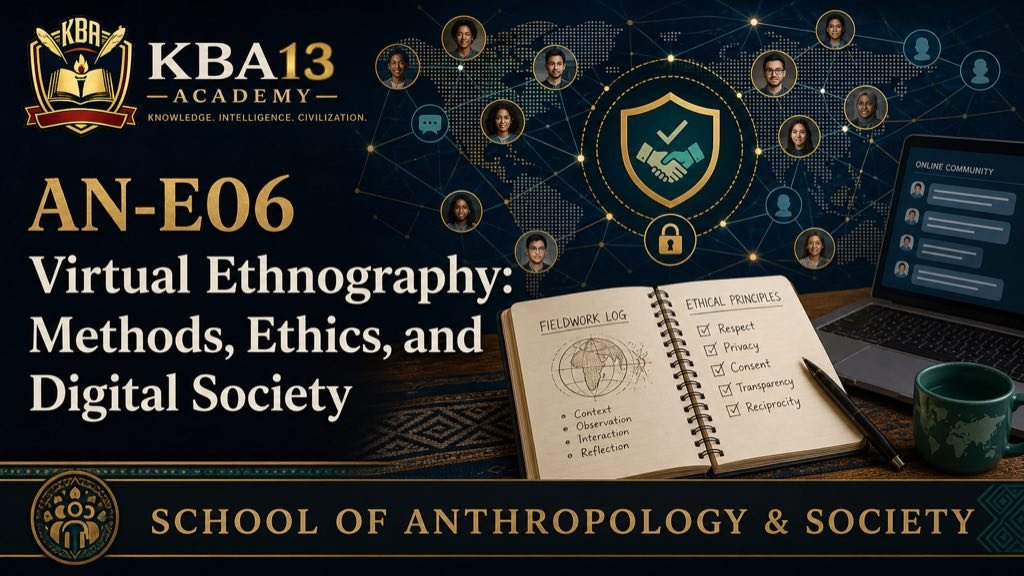
Virtual Ethnography: Methods, Ethics, and Digital Society is the flagship course of the School of Anthropology & Society. It equips learners to design, conduct, analyze, document, and report ethical virtual ethnography in digitally mediated societies.
Primary KBA13 Source
This course draws on Dari Artificial Intelligence ke Virtual Ethnography: Kajian tentang Masyarakat Digital di Indonesia by Kamaruzzaman Bustamam Ahmad (KBA13 Insight). The book is a foundational source. Its chapters, arguments, cases, and references will be mapped only from the verified manuscript; where the full text is unavailable, materials are marked SOURCE MANUSCRIPT REQUIRED and are never fabricated.
Why This Course Matters
Social life increasingly unfolds across platforms and algorithms. Virtual ethnography lets researchers study these worlds rigorously and ethically, treating them as connected to embodied life rather than as a detached, unreal domain.
Target Learners
- Anthropology students
- Social, media, and digital-culture researchers
- Lecturers and postgraduate students
- Religious-studies and communication researchers
- Journalists and policy researchers
- Professionals studying online communities
Prerequisites
AN-E01 and AN-E02 recommended.
Measurable Learning Outcomes
- Distinguish digital anthropology, virtual ethnography, and related fields
- Construct an ethical virtual field site
- Conduct virtual participant observation
- Apply ethics, privacy, and consent standards online
- Analyze algorithmic mediation and platform power
- Analyze virtual ethnographic material
- Write a responsible virtual ethnography report
Required Module Architecture
- Module 0 — Start Here: Orientation, Ethics, and Research Boundaries
- Module 1 — From Ethnography to Virtual Ethnography
- Module 2 — Constructing the Virtual Field Site
- Module 3 — Identity, Interaction, Community, and Digital Culture
- Module 4 — Virtual Participant Observation and Digital Data
- Module 5 — Ethics, Privacy, Consent, and Vulnerability
- Module 6 — Algorithms, Artificial Intelligence, and Platform Power
- Module 7 — Analyzing Virtual Ethnographic Material
- Module 8 — Writing and Presenting Virtual Ethnography
- Module 9 — Applied Virtual Ethnography Project
Assessment Framework
- Baseline digital-research self-assessment
- Platform and field-site mapping exercise
- Virtual participant-observation exercise
- Digital field-note assignment
- Ethics and privacy case analysis
- Algorithmic mediation analysis
- Virtual ethnographic coding exercise
- Researcher positionality statement
- Final Virtual Ethnography proposal
- Final applied project
Final Project
Design a Responsible Virtual Ethnography Study, covering topic, research problem and question, digital field site, participant/community definition, platform context, access strategy, ethics and consent, privacy strategy, sampling, data types, field-note system, analysis plan, positionality, AI-use plan, limitations, and output format. Learners are not required to collect sensitive real-world data without ethics approval; a simulated or publicly documented case may be used.
Certificate
Certificate of Completion in Virtual Ethnography: Methods, Ethics, and Digital Society (future pathway: Professional Certificate in Virtual Ethnography). It does not claim formal academic credit, professional licensure, ethics approval, or authorization to conduct unrestricted digital surveillance.
Ethics Notice
Publicly visible digital content is not automatically ethically unrestricted. Platform users remain human participants. The course does not teach unauthorized scraping, access-control bypass, private-account intrusion, or surveillance.
Responsible AI
AI may assist with organization and analysis but never invents field notes, participants, usernames, posts, comments, or findings. All AI use is disclosed and human-verified.
Related Book, Resources, and Pathway
Related: the KBA13 Virtual Ethnography book page, Digital Library record, the Virtual Ethnography Lab (36 resources), and Pathway 3 — Virtual Ethnography.
Instructor
INSTRUCTOR PENDING OWNER CONFIRMATION
Enrollment
Price: Owner Approval Required. Enrollment disabled until substantive content is completed and reviewed.
Content Status: DRAFT — Flagship shell with full module architecture; lessons under construction; book mapping pending verified manuscript. · AI-assisted; human academic/ethics/source review pending. Non-degree. INSTRUCTOR PENDING OWNER CONFIRMATION.
Course Content
Module 0 — Start Here: Orientation, Ethics, and Research Boundaries
-
Lesson 0.1 — Orientation and Research Boundaries
Module 1 — From Ethnography to Virtual Ethnography
Module 2 — Constructing the Virtual Field Site
Module 3 — Identity, Interaction, Community, and Digital Culture
Module 4 — Virtual Participant Observation and Digital Data
Student Ratings & Reviews