
Kajian Strategis · Politik Indonesia, Legitimasi & Proyeksi 2029
Dua Tahun Prabowo–Gibran:Legitimasi Distributif, Legitimasi Epistemik, dan Jalan Menuju 2029
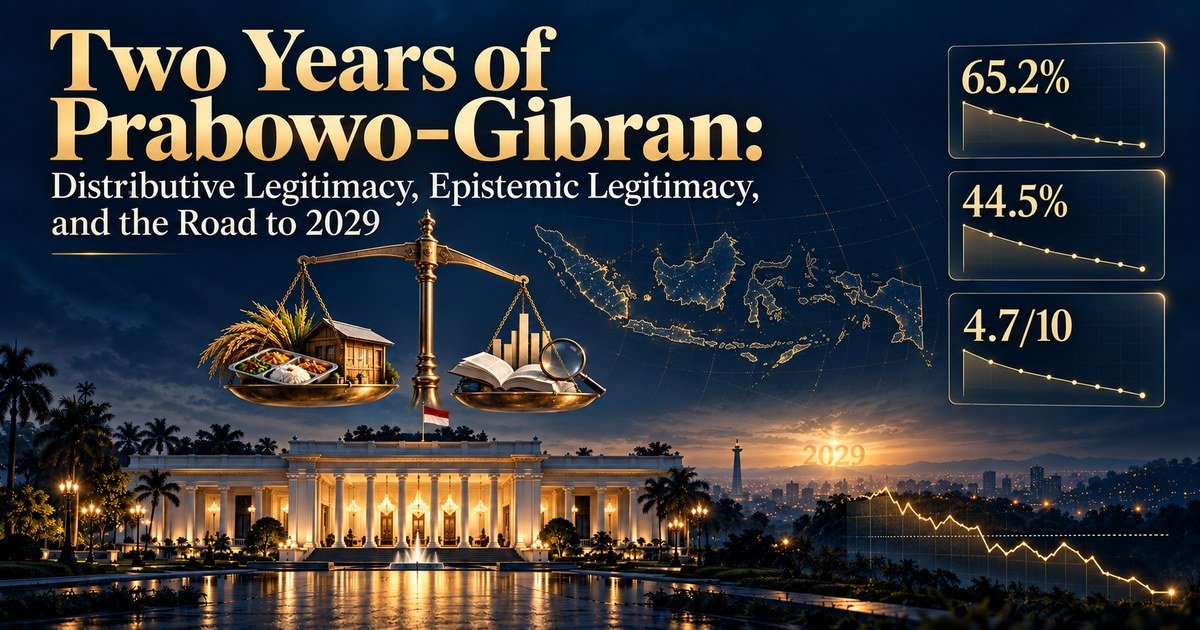
Pada ulang tahun kedua, pemerintahan Prabowo–Gibran dinilai puas oleh mayoritas warga perdesaan tetapi kehilangan kepercayaan kaum terdidik, pasar, dan indeks demokrasi internasional. Kajian ini menjelaskan mengapa jarak itu, bukan angka kepuasan rata-rata, merupakan risiko terbesar menuju 2029.
Abstrak
Kajian ini menilai dua tahun pemerintahan Prabowo–Gibran melalui pembedaan antara legitimasi distributif, yang lahir dari apa yang diterima warga dari negara, dan legitimasi epistemik, yang lahir dari keyakinan bahwa negara dikelola secara masuk akal dan dapat dikoreksi. Tiga survei Oktober 2026 memperlihatkan keterbelahan yang sistematis: Parameter Politik mencatat kepuasan 65,2 persen dengan gradien tajam menurut pendidikan dan kelas, SMRC mencatat 44,5 persen setelah turun sekitar 37 poin dalam sebelas bulan, dan CELIOS mencatat skor 4,7 dari publik daring serta 2,9 dari ahli. Indeks V-Dem, Freedom House, dan EIU menempatkan Indonesia di zona abu-abu otokratisasi. Analisis atas data fiskal, kurs, program Makan Bergizi Gratis dan Koperasi Merah Putih, pencopotan Menteri Keuangan, pelantikan pejabat Oktober, putusan Mahkamah Konstitusi tentang dokumen pendidikan Wakil Presiden, serta krisis komunikasi menunjukkan bahwa kedua legitimasi terhubung melalui ruang fiskal yang kian sempit. Perbandingan dengan Brasil, Filipina, Meksiko, dan India menunjukkan bahwa legitimasi distributif dapat menunda tetapi tidak menggantikan legitimasi epistemik. Kajian ini menguji argumen tandingan terkuat, mengajukan empat skenario berprobabilitas beserta indikator pemantauan, dan merumuskan rekomendasi bagi aktor nasional maupun internasional.
Pemerintahan ini menang dalam legitimasi distributif dan kalah dalam legitimasi epistemik, dan ruang fiskal yang menyempit dapat mengubah jarak di antara keduanya menjadi risiko politik terbesar menuju 2029.
- DataSurvei PPI, SMRC, CELIOS, Indikator; BPS, JISDOR, APBN; V-Dem, Freedom House, EIU
- KerangkaLegitimasi distributif vs epistemik, jebakan dua legitimasi, perbandingan empat negara
- ProyeksiEmpat skenario berprobabilitas, indikator pemantauan, dan rekomendasi hingga 2029
Kata kunci
- Dua Tahun Prabowo–Gibran
- Legitimasi Distributif
- Legitimasi Epistemik
- Survei Kepuasan Publik
- Ruang Fiskal
- Kemunduran Demokrasi
- Makan Bergizi Gratis
- Pemilu 2029
Ringkasan Eksekutif: Dua Tahun, Dua Jenis Legitimasi
Pada 20 Oktober 2026, pemerintahan Prabowo Subianto dan Gibran Rakabuming Raka genap berusia dua tahun sejak pelantikan 20 Oktober 2024, dan pertanyaan pokok kajian ini sederhana tetapi menentukan: kepada siapa pemerintahan ini masih dipercaya, mengapa kepercayaan itu runtuh pada lapisan tertentu dan bertahan pada lapisan lain, dan apa artinya pola itu bagi jalan menuju Pemilu 2029. Jawaban ringkasnya adalah bahwa pemerintahan ini sedang menang dalam legitimasi distributif, yakni kepercayaan yang lahir dari apa yang diterima warga dari negara, tetapi kalah dalam legitimasi epistemik, yakni keyakinan bahwa negara dikelola secara masuk akal, berbasis data, dan dapat dikoreksi. Tiga angka dari pekan yang sama memperlihatkan keterbelahan itu. Parameter Politik Indonesia mencatat kepuasan 65,2 persen dalam survei tatap muka; Saiful Mujani Research and Consulting (SMRC) mencatat 44,5 persen, terendah sepanjang pemerintahan ini, dengan 53,4 persen warga kini kurang atau tidak puas; dan rapor Center of Economic and Law Studies (CELIOS) memberi kabinet nilai 4,7 dari publik daring dan 2,9 dari para ahli. Jarak di antara kedua jenis legitimasi itu, bukan tingkat kepuasan rata-rata, merupakan risiko politik terbesar hingga 2029, karena kedua legitimasi itu terhubung melalui jalur fiskal dan pasar yang dapat mengubah kecurigaan kaum terdidik menjadi kesulitan di dapur rumah tangga.
Persoalan ini melampaui Indonesia. Laporan Demokrasi 2026 dari V-Dem Institute mencatat bahwa 74 persen penduduk dunia kini hidup di bawah rezim otokratis, bahwa 44 negara sedang mengalami otokratisasi, dan bahwa Indonesia termasuk di dalamnya, dengan klasifikasi otokrasi elektoral di wilayah abu-abu dekat ambang demokrasi elektoral. Pada saat yang sama, sejumlah pemerintahan besar di Selatan Global, dari Meksiko hingga India, menguji satu hipotesis politik yang sama: apakah program distribusi berskala besar dapat menggantikan kualitas kelembagaan sebagai fondasi legitimasi. Indonesia, salah satu negara dengan pemilihan presiden langsung terbesar di dunia sekaligus negara yang membangun program makan bergizi dengan sekitar 57 juta penerima, adalah laboratorium paling penting bagi hipotesis itu. Apabila model legitimasi distributif mampu bertahan di Indonesia tanpa pemulihan legitimasi epistemik, pelajaran itu akan dibaca oleh pemerintahan lain di Asia, Amerika Latin, dan Afrika sebagai izin untuk menukar akuntabilitas dengan bantuan. Apabila model itu gagal, kegagalannya akan memperlihatkan batas-batas politik kesejahteraan yang dipersonalisasi.
Kajian ini sampai pada tiga penilaian utama. Pertama, dengan keyakinan tinggi, kepuasan publik terbelah secara sistematis menurut pendidikan, kelas, dan wilayah, sehingga perdebatan tentang survei mana yang benar adalah perdebatan yang salah arah. Kedua, dengan keyakinan sedang, ruang fiskal yang menyempit akan menjadi jalur utama penularan dari krisis legitimasi epistemik ke krisis legitimasi distributif dalam dua belas hingga delapan belas bulan ke depan, terutama karena defisit 2026 diproyeksikan mendekati batas tiga persen. Ketiga, dengan keyakinan rendah hingga sedang, retakan elite terbuka sebelum 2029 masih kecil kemungkinannya, tetapi strukturnya kini lebih lengkap daripada sebulan lalu setelah pencopotan Menteri Keuangan, tiga gelombang pelantikan pejabat pada Oktober, dan putusan Mahkamah Konstitusi tentang dokumen pendidikan Wakil Presiden. Skenario paling mungkin adalah stabilitas tanpa kepercayaan, dan jendela untuk mengubahnya adalah sepuluh minggu tersisa pada 2026.
Kerangka Analitis dan Catatan Metode
Literatur teori politik lazim membedakan legitimasi input, yang bersumber dari prosedur seperti pemilu, dari legitimasi output, yang bersumber dari hasil kebijakan. Pembedaan itu berguna, tetapi terlalu kasar untuk menjelaskan pola Indonesia pada 2026, karena dua kelompok warga yang sama-sama menilai hasil kebijakan ternyata memakai ukuran yang berbeda. Kajian ini karena itu memilah legitimasi output menjadi dua. Legitimasi distributif adalah kepercayaan yang tumbuh dari pengalaman langsung menerima sesuatu dari negara: makanan di sekolah, bantuan sosial, subsidi pupuk, harga gabah yang dijaga, atau rumah bersubsidi. Ia bersifat material, dekat, dan nyaris tidak membutuhkan penjelasan, karena buktinya hadir di meja makan. Legitimasi epistemik adalah kepercayaan yang tumbuh dari keyakinan bahwa keputusan diambil berdasarkan data, anggaran dikelola dengan disiplin, pejabat dipilih karena kompetensi, aturan berlaku sama bagi semua, dan kritik diolah sebagai informasi. Ia bersifat kognitif, berjarak, dan sangat bergantung pada mutu informasi di ruang publik. Kedua jenis legitimasi tersebar tidak merata: warga perdesaan dan berpendidikan rendah cenderung menilai negara sebagai pemberi, sedangkan warga perkotaan, profesional, dan lulusan perguruan tinggi menilai negara sebagai pengelola sistem yang cara kerjanya mereka pahami, dari pasar uang hingga birokrasi.
Dari pembedaan itu diturunkan tiga konsep kerja. Konsep pertama adalah jebakan dua legitimasi: legitimasi distributif harus terus dibiayai, sedangkan hilangnya legitimasi epistemik menaikkan biaya pembiayaan negara melalui imbal hasil yang lebih tinggi dan kurs yang lebih lemah, sehingga kehilangan kepercayaan kaum terdidik pada akhirnya dapat menggerus kepercayaan kaum penerima manfaat. Konsep kedua adalah stabilitas tanpa katup, istilah yang dikembangkan dalam analisis Peta Konflik Elite Indonesia 2026–2035 (Januari 2026) untuk menggambarkan sistem yang tampak tenang karena hampir semua aktor utamanya berada dalam satu koalisi, tetapi justru kehilangan mekanisme pelepasan tekanan secara bertahap. Konsep ketiga adalah kepatuhan dingin, sebagaimana dirumuskan dalam audit prediksi Dari Goro-Goro ke Huru-Hara (September 2026): keadaan ketika aturan tetap ditaati tetapi kepercayaan menipis, dan warga perlahan mencari solusi di luar sistem formal. Ketiga konsep ini tidak dimaksudkan sebagai label moral, melainkan sebagai alat diagnosis yang menghasilkan dugaan yang dapat diuji dan dibantah oleh data.
Kajian ini memakai triangulasi tiga jenis bukti untuk periode Agustus hingga 20 Oktober 2026. Jenis pertama adalah survei opini dengan metode berbeda, yang dibaca berdampingan untuk menemukan pola, bukan untuk memilih pemenang. Jenis kedua adalah data resmi tentang pertumbuhan, kemiskinan, kurs, dan anggaran negara, termasuk rilis Badan Pusat Statistik, Bank Indonesia, dan Kementerian Keuangan sebagaimana dilaporkan media arus utama. Jenis ketiga adalah indeks demokrasi internasional dari V-Dem, Freedom House, dan Economist Intelligence Unit, yang mengukur mutu kelembagaan dan karena itu menjadi wakil kasar bagi dimensi epistemik. Dokumen arsip surat kabar dan majalah dipakai untuk menempatkan perdebatan masa kini dalam ingatan kelembagaan yang lebih panjang. Penilaian kunci diberi label keyakinan tinggi, sedang, atau rendah: keyakinan tinggi berarti beberapa sumber independen dengan metode berbeda menunjuk ke arah yang sama; keyakinan sedang berarti bukti konsisten tetapi bergantung pada asumsi penting; keyakinan rendah berarti bukti terbatas atau dapat ditafsirkan secara berbeda. Angka peluang skenario adalah penilaian analitis, bukan keluaran model statistik.
Indonesia dalam Peta Global: Indeks Demokrasi dan Kasus Pembanding
Indeks internasional memberi gambaran yang lebih suram daripada survei kepuasan, dan perbedaan itu sendiri merupakan data penting. Laporan Demokrasi 2026 V-Dem menggolongkan Indonesia sebagai negara yang sedang mengalami otokratisasi dalam pola bell-turn sejak 2019, yakni kemunduran setelah periode demokratisasi, dengan penurunan Indeks Demokrasi Liberal sebesar 0,249 poin, kelima terbesar di antara sepuluh kasus serupa. Indonesia kini diklasifikasikan sebagai otokrasi elektoral dengan tanda plus, artinya berada di wilayah abu-abu yang dapat saja masuk kategori lebih tinggi. Menurut olahan Databoks atas data V-Dem, Indeks Demokrasi Liberal Indonesia turun dari sekitar 0,5 pada 2016 menjadi sekitar 0,3 pada 2025, titik terendah dalam satu dekade. Freedom House dalam Freedom in the World 2026 memberi Indonesia skor 56 dari 100 dengan status Sebagian Bebas, terdiri atas 28 dari 40 untuk hak politik dan 28 dari 60 untuk kebebasan sipil, serta menyebut korupsi sistemik, diskriminasi terhadap minoritas, konflik Papua, dan penggunaan politis pasal pencemaran nama baik dan penodaan agama sebagai persoalan menahun. Dalam Indeks Demokrasi EIU, skor Indonesia untuk 2024 turun dari 6,53 menjadi 6,44 dengan peringkat 59, tetap dalam kategori demokrasi cacat.
Ketiga indeks itu perlu dibaca dalam konteks global. V-Dem mencatat rekor 41 persen penduduk dunia, atau 3,4 miliar orang, tinggal di negara yang sedang mengalami otokratisasi, dan bahwa jumlah otokrasi, 92, kini melampaui jumlah demokrasi, 87. Amerika Serikat sendiri untuk pertama kalinya masuk daftar negara yang mengalami otokratisasi. EIU memberi nuansa berbeda: rata-rata skor global dalam Indeks Demokrasi 2025 naik tipis dari 5,17 menjadi 5,19, sehingga lembaga itu menyebut demokrasi global mulai stabil setelah delapan tahun merosot, sementara Amerika Serikat turun ke peringkat 34. Bagi kajian ini, makna terpenting dari indeks-indeks tersebut bukanlah peringkat Indonesia semata, melainkan kesenjangan antara apa yang diukur indeks kelembagaan dan apa yang diukur survei kepuasan. Indeks menilai pengawasan terhadap eksekutif, independensi peradilan, kebebasan berekspresi, dan kesetaraan di depan hukum, yakni unsur-unsur legitimasi epistemik. Survei kepuasan, terutama di kalangan penerima manfaat, lebih banyak menangkap legitimasi distributif. Ketika keduanya bergerak ke arah berbeda, sebuah negara dapat tampak populer dan sekaligus tergerus secara kelembagaan, dan kondisi itulah yang kini dialami Indonesia dengan keyakinan tinggi.
Indikator kelembagaan juga membantu menjelaskan mengapa kemerosotan kepuasan pada 2026 terjadi begitu cepat. Pemerintahan yang kehilangan pengimbang di parlemen harus mengandalkan lembaga lain untuk menjaga kredibilitasnya: peradilan, auditor negara, pers, dan lembaga statistik. Apabila lembaga-lembaga itu dipersepsikan melemah, setiap guncangan ekonomi atau skandal program tidak lagi ditafsirkan sebagai kegagalan teknis yang dapat diperbaiki, melainkan sebagai gejala sistem yang tidak dapat dipercaya. Dengan kata lain, skor indeks yang rendah tidak menyebabkan kemarahan publik secara langsung, tetapi menurunkan ambang batas di mana kekecewaan berubah menjadi ketidakpercayaan. Mekanisme ini, yang dapat disebut sebagai hilangnya penyangga epistemik, menjelaskan mengapa kepuasan terhadap Presiden dalam data SMRC dapat jatuh sekitar 37 poin dalam sebelas bulan tanpa adanya satu krisis tunggal yang dramatis. Keyakinan atas mekanisme ini sedang, karena data panel yang dapat mengujinya secara langsung belum tersedia.
Empat kasus pembanding, yakni Brasil, Filipina, Meksiko, dan India, menunjukkan bahwa ketegangan antara legitimasi distributif dan epistemik bukan kekhasan Indonesia, melainkan salah satu garis patahan utama politik negara berkembang berpenduduk besar. Brasil memberi contoh bagaimana pemulihan kelembagaan dapat berjalan berdampingan dengan polarisasi elektoral yang tetap tajam. Pada September 2025, Panel Pertama Mahkamah Agung Federal Brasil menjatuhkan hukuman 27 tahun tiga bulan kepada mantan Presiden Jair Bolsonaro atas upaya meruntuhkan negara demokratis setelah kekalahannya pada 2022. V-Dem kini menggolongkan Brasil sebagai negara yang sedang berdemokratisasi kembali dalam pola U-turn. Namun pemulihan kelembagaan itu tidak otomatis menghasilkan dukungan bagi petahana: pada putaran pertama pemilihan presiden 4 Oktober 2026, Flávio Bolsonaro memperoleh sekitar 47 persen suara sah dan Lula sekitar 45 persen, sehingga keduanya bertarung kembali pada 25 Oktober. Pelajarannya bagi Indonesia adalah bahwa legitimasi epistemik yang dipulihkan oleh lembaga peradilan memperkuat sistem, bukan otomatis memperkuat pemerintah, dan bahwa kepuasan ekonomi tetap menjadi penentu elektoral yang terpisah.
Filipina menunjukkan bagaimana program distribusi dapat berbalik menjadi mesin delegitimasi. Presiden Ferdinand Marcos Jr. membuka sendiri penyimpangan dalam proyek pengendalian banjir dalam pidato kenegaraan 2025, tetapi janji bahwa pelakunya akan dipenjara sebelum Natal tidak terpenuhi. Menurut laporan Daily Tribune, survei Social Weather Stations pada 24 hingga 30 November 2025 mencatat kepercayaan bersih terhadap Marcos jatuh menjadi minus 3, sementara Pulse Asia mencatat 48 persen responden bersikap kritis dan hanya 34 persen yang menghargai kinerjanya. Unjuk rasa besar seperti Trillion Peso March pada 21 September 2025 lahir bukan dari ketiadaan proyek, melainkan dari keyakinan bahwa proyek itu menjadi saluran rente. Paralelnya dengan Makan Bergizi Gratis cukup jelas: semakin besar sebuah program, semakin besar pula kerusakan legitimasi ketika tata kelolanya dipersepsikan bocor, dan pengungkapan tanpa penegakan hukum yang tuntas justru mempercepat kerusakan itu.
Meksiko memberi pelajaran yang paling tidak nyaman. Pada Juni 2024, survei Enkoll dan lembaga lain yang dipesan Morena menemukan 83 persen responden menilai reformasi peradilan perlu, termasuk pemilihan hakim agung secara langsung, meskipun sekitar separuh responden belum pernah mendengar tentang reformasi itu sebelum ditanya. V-Dem kemudian menggolongkan Meksiko sebagai otokrasi elektoral sejak 2024. Kasus ini memperlihatkan bahwa legitimasi mayoritarian dapat memberi restu bagi pelemahan pengawasan kelembagaan. Namun dukungan semacam itu juga memiliki batas: survei AtlasIntel untuk Bloomberg pada 20 hingga 24 Maret 2026 mencatat persetujuan terhadap Presiden Claudia Sheinbaum turun ke sekitar 54 persen, terendah sepanjang masa jabatannya, dengan korupsi dan rasa tidak aman sebagai kekhawatiran utama. India melengkapi gambaran ini. Yamini Aiyar dalam esai Citizen vs labharthi? menyebut model kesejahteraan pemerintahan Modi sebagai welfarisme patrimonial, ketika manfaat pribadi seperti gas masak, rumah, dan jatah pangan dilekatkan pada citra pemimpin dan warga diposisikan sebagai penerima, bukan pemegang hak. Model itu efektif, tetapi tidak tanpa batas: dalam Pemilu 2024, BJP hanya meraih 240 kursi, turun 63 kursi dan kehilangan mayoritas tunggal, dengan pengangguran sebagai isu yang menonjol.
Keempat kasus itu menempatkan Indonesia di antara pola Meksiko dan India, dengan tiga kekhasan. Kekhasan pertama adalah kecepatan: penurunan kepuasan sekitar 37 poin dalam kurang dari satu tahun jauh lebih tajam daripada penurunan sekitar sembilan poin dalam dua bulan yang tercatat pada Sheinbaum. Kekhasan kedua adalah batas fiskal tiga persen dari produk domestik bruto, yang membuat jebakan dua legitimasi bekerja lebih cepat daripada di negara yang tidak memiliki jangkar fiskal serupa. Kekhasan ketiga adalah koalisi parlemen yang nyaris tanpa oposisi, sehingga fungsi pengimbang berpindah sepenuhnya ke luar lembaga perwakilan. Dari perbandingan ini dapat ditarik penilaian dengan keyakinan sedang bahwa legitimasi distributif dapat menunda, tetapi tidak dapat menggantikan, legitimasi epistemik; pemerintahan yang mengandalkan yang pertama tanpa merawat yang kedua akhirnya menghadapi tagihan, baik dalam bentuk kekalahan elektoral sebagian seperti di India, kejatuhan kepercayaan seperti di Filipina, maupun erosi dukungan di tengah konsolidasi kelembagaan seperti di Meksiko.
Legitimasi distributif dapat menunda, tetapi tidak dapat menggantikan, legitimasi epistemik.
Mandat 2024 dan Peta Kepercayaan yang Terbelah
Pemerintahan ini memulai perjalanannya dengan modal yang hampir sempurna: kemenangan satu putaran pada Februari 2024, kabinet besar dengan puluhan kementerian dan wakil menteri, serta koalisi parlemen yang merangkul hampir semua partai. Modal semacam itu mengandung risikonya sendiri, dan perdebatan tentang risiko itu sudah lama tercatat. Pada tahun 2014, L. Wilardjo dalam harian Kompas yang berjudul Kekuatan Pengimbang menimbang pentingnya kekuatan yang mengoreksi pemerintah, sementara Dorodjatun Kuntjoro-Jakti dalam harian yang sama menulis Menang dan Kalah dalam Politik (8 November 2014) tentang cara demokrasi mengelola kemenangan tanpa meniadakan pihak yang kalah. Ironi sejarahnya tajam: tokoh yang pada 2014 memimpin poros pengimbang kini memimpin pemerintahan yang nyaris tanpa pengimbang di parlemen. Persoalannya struktural, bukan personal. Ketika fungsi pengimbang hilang dari lembaga perwakilan, fungsi itu berpindah ke lembaga survei, kampus, media sosial, dan pada titik tertentu ke jalanan. Gelombang protes akhir Agustus 2025, yang dipicu tunjangan perumahan Rp50 juta per bulan bagi anggota DPR dan memuncak setelah pengemudi ojek daring Affan Kurniawan tewas dilindas kendaraan Brimob, menyebar dari Jakarta ke Surabaya, Yogyakarta, Medan, Makassar, hingga Manokwari, dan memperlihatkan bahwa koalisi besar tidak identik dengan stabilitas sosial.
Ingatan tentang akhir Orde Baru relevan, meskipun harus dipakai dengan hati-hati. Pada tahun 1997, Ahmad Suhelmi dalam harian Republika yang berjudul Sirkulasi Elite Politik Orde Baru menulis tentang tersumbatnya pergantian elite hanya beberapa bulan sebelum krisis moneter, sedangkan Jeffrey A. Winters dalam buku Dosa-Dosa Politik Orde Baru (Djambatan, 1999) membedah bagaimana stabilitas yang dibiayai akomodasi elite rentan terhadap guncangan ekonomi. Indonesia 2026 jelas berbeda: pemilu kompetitif, pers relatif bebas, dan masyarakat sipil jauh lebih kuat. Tetapi pelajaran strukturalnya tetap berlaku, sebab akomodasi elite yang luas dibiayai sumber daya negara, dan ketika sumber daya menyempit, biaya akomodasi tidak ikut turun.
Tiga survei utama pada Oktober 2026 harus dibaca berdasarkan metodenya. Parameter Politik Indonesia, dirilis Adi Prayitno pada 18 Oktober, mewawancarai 1.200 responden secara tatap muka di 38 provinsi pada 26 September hingga 6 Oktober dengan margin of error sekitar 2,83 persen. SMRC, diumumkan Deni Irvani pada 16 Oktober, mewawancarai 1.213 responden pada 1 hingga 10 Oktober, yakni 1.013 pemilik telepon melalui telepon dan 200 warga tanpa telepon secara tatap muka, dengan margin of error sekitar 2,9 persen. CELIOS menggabungkan penilaian 129 ahli yang dijaring secara bola salju dan 1.142 responden publik yang dijangkau melalui iklan Meta dengan teknik nonprobabilitas dan pembobotan, pada 15 September hingga 9 Oktober. Rapor CELIOS karena itu tidak dapat dibaca sebagai potret seluruh pemilih, melainkan sebagai suara kelompok yang aktif secara digital dan kritis.
Bila diletakkan berdampingan, ketiga survei menghasilkan pola yang konsisten. Data Parameter Politik menunjukkan kepuasan 75,3 persen di kelas bawah tetapi hanya 35,5 persen di kelas menengah atas dan 25 persen di kelas atas; 79,3 persen di kalangan yang tidak bersekolah atau tidak tamat sekolah dasar tetapi hanya 43,2 persen di kalangan lulusan perguruan tinggi. Petani paling puas dengan angka 76,3 persen, pelajar dan mahasiswa 48,6 persen, dan kalangan profesional seperti dokter dan pengacara paling rendah, 33 persen. Warga perdesaan lebih puas daripada warga perkotaan, 70,2 berbanding 61,4 persen; Kalimantan dan Sulawesi mencatat 81,3 persen, sedangkan Jawa Tengah, Jawa Timur, dan Yogyakarta hanya 57,6 persen. Bahkan di antara pemilih Prabowo–Gibran sendiri, kepuasan hanya 73,4 persen. Skor CELIOS dari para ahli, 2,9, jauh di bawah skor publik daringnya, 4,7, dan IDN Times melaporkan bahwa 71 persen ahli dalam survei itu menilai kapasitas kepemimpinan Presiden kurang memadai. Gradien pendidikan dan kelas ini adalah tanda paling jelas dari pembelahan antara legitimasi distributif dan epistemik.
SMRC menambahkan dimensi waktu yang menentukan. Kepuasan terhadap Presiden tercatat 81,2 persen pada November 2025, 66,4 persen pada Februari–Maret 2026, 51,1 persen pada Juli, dan 44,5 persen pada Oktober 2026, sementara proporsi yang tidak puas naik dari 16 menjadi 53,4 persen. Sebagai pembanding, Indikator Politik Indonesia pada 20 hingga 27 Oktober 2025 mencatat 77,7 persen publik puas atas setahun kerja pemerintah. Kemerosotan ini sangat terkait dengan persepsi ekonomi: di antara warga yang menilai ekonomi nasional baik, 87 persen puas terhadap Presiden; di antara yang menilai buruk, hanya 23 persen, dan kelompok kedua kini menjadi mayoritas, 50,8 persen. Perbedaan metode tentu menjelaskan sebagian selisih antarsurvei, karena wawancara tatap muka menjangkau lebih banyak warga perdesaan dan berpendidikan rendah. Namun dua fakta membuat penjelasan metodologis saja tidak memadai: tren SMRC diukur dengan metode yang sama dari waktu ke waktu, dan gradien pendidikan muncul di dalam survei tatap muka itu sendiri. Kesimpulan bahwa kepercayaan publik terbelah secara struktural, bukan sekadar terdistorsi oleh metode, karena itu dinilai dengan keyakinan tinggi.
Ekonomi dan Fiskal: Statistik, Pengalaman, dan Batas Tiga Persen
Secara makro, data resmi tidak menggambarkan ekonomi yang runtuh. Badan Pusat Statistik mencatat pertumbuhan 5,29 persen pada kuartal II 2026, dan menurut data BPS yang dikutip Badan Komunikasi Pemerintah, tingkat kemiskinan turun menjadi 8,07 persen pada Maret 2026, dengan 22,93 juta penduduk miskin, berkurang sekitar 920 ribu orang dibanding Maret 2025, sementara kemiskinan ekstrem disebut turun ke 0,85 persen pada 2025. Namun separuh warga menilai ekonomi memburuk. CELIOS mencatat 53 persen respondennya menilai kondisi ekonomi lebih buruk dibanding tahun sebelumnya dan 75 persen merasa tertekan oleh kebijakan pemerintah. Garis kemiskinan mengukur ambang bertahan hidup, sedangkan kecemasan ekonomi mengukur kemampuan menjaga taraf hidup, sehingga keduanya dapat bergerak berlawanan. Kelas menengah bawah, kelompok yang tidak cukup miskin untuk menerima bantuan tetapi tidak cukup kaya untuk terlindung dari kenaikan harga, adalah wilayah tempat kecemasan itu paling pekat, dan kelompok inilah yang paling cepat berpindah dari lensa distributif ke lensa epistemik.
Rupiah adalah indikator paling cepat dari jarak antara statistik dan kepercayaan. Pada 4 Juni 2026, rupiah ditutup pada Rp18.033 per dolar, level penutupan terlemah tahun ini, di tengah penguatan dolar global, kenaikan harga minyak, dan arus keluar modal. Sejak pertengahan Juli, kurs referensi JISDOR Bank Indonesia bertahan di sekitar Rp18.000, misalnya Rp18.064 pada 15 Juli dan Rp18.041 pada 16 Juli. Pada Oktober, JISDOR bergerak dari Rp17.899 pada 12 Oktober menjadi Rp18.052 pada 16 Oktober. Data ini penting untuk membedakan dua jenis risiko: rupiah belum mengalami kejatuhan tidak tertib yang menembus rekor baru dalam satu atau dua hari, tetapi ia telah menetap pada tingkat lemah selama lebih dari tiga bulan. Pelemahan yang menetap merambat ke harga bahan baku impor, pangan olahan, dan beban utang luar negeri, dan bagi kelas menengah perkotaan ia dibaca sebagai penilaian pasar atas mutu tata kelola. Di titik inilah ekonomi bertemu legitimasi epistemik.
Jalur fiskal adalah mata rantai paling kritis dalam jebakan dua legitimasi. Hingga akhir September 2026, defisit APBN mencapai Rp319 triliun atau 1,24 persen PDB, dengan pendapatan Rp2.341,5 triliun yang tumbuh 25,5 persen dan belanja Rp2.660,5 triliun yang tumbuh 19 persen. Menteri Keuangan Suahasil Nazara menyatakan pelaksanaan anggaran masih sesuai rencana, dengan target defisit setahun 2,68 persen dan proyeksi akhir tahun sekitar 2,8 persen. Akan tetapi, editorial Kabar Bursa mencatat bahwa melalui surat S-708/MK.03/2026 tertanggal 8 Oktober 2026, kementerian dan lembaga diminta memangkas 30 persen sisa anggaran perjalanan dinas dan menunda pengadaan yang belum berkontrak; dengan proyeksi defisit 2,85 persen, jarak terhadap batas tiga persen tinggal sekitar 0,15 poin persentase. Pengereman belanja diskresioner pada kuartal terakhir bukan krisis, tetapi merupakan tanda bahwa ruang fiskal untuk membiayai legitimasi distributif sedang menipis. Penilaian bahwa jalur fiskal akan menjadi saluran utama penularan krisis legitimasi pada 2027 dibuat dengan keyakinan sedang.
Ketimpangan antardaerah memperumit gambaran ini. Analisis Aceh sebagai Cermin Indonesia (September 2026) mencatat bahwa pemulihan pascabanjir 2025 di sebagian Aceh masih berjalan berbulan-bulan setelah kejadian, sehingga warga terdampak mengalami negara sebagai janji yang tertunda; Parameter Politik mencatat kepuasan di Sumatra 63,1 persen, di bawah rata-rata nasional. Kepuasan petani, 76,3 persen, juga lebih rapuh daripada kelihatannya. Kebijakan harga dan input memang nyata, termasuk kenaikan harga pembelian gabah menjadi Rp6.500 per kilogram dan kuota pupuk bersubsidi 9,5 juta ton, tetapi analisis Petani, Ingatan September, dan Sistem Peringatan Dini (September 2026) mencatat 341 letusan konflik agraria pada 2025 menurut Konsorsium Pembaruan Agraria, tertinggi dalam lima tahun. DPR mengesahkan Undang-Undang Pengaturan Reforma Agraria pada 22 September 2026, dan Dedi Prasetyo dilantik sebagai Kepala Badan Reforma Agraria Nasional pada 1 Oktober. Harapan yang naik tanpa implementasi cepat adalah resep kekecewaan, karena bagi petani legitimasi distributif paling dalam bukanlah pupuk, melainkan kepastian atas tanah.
Program Unggulan dan Politik Teknokrasi
Makan Bergizi Gratis adalah wajah pemerintahan ini dan sumber legitimasi distributifnya yang paling kuat. Hingga akhir September 2026, realisasi anggaran MBG mencapai Rp153,2 triliun dengan jangkauan sekitar 57 juta penerima manfaat. Data SMRC memperlihatkan eratnya kaitan program ini dengan penilaian terhadap Presiden: di antara warga yang sangat puas dengan pelaksanaan MBG, 79 persen puas terhadap Presiden; di antara yang sama sekali tidak puas, hanya 15 persen. Presiden sendiri, dalam pidato di Gontor pada 19 September 2026, menegaskan bahwa pemerintahannya telah membuktikan diri bukan pemimpin yang hanya berbicara, dengan menyebut swasembada pangan dan berhentinya impor solar sejak 1 Juli 2026 melalui mandat biodiesel B50 sebagai bukti. Klaim-klaim itu bekerja kuat pada lensa distributif, tetapi justru di sinilah persoalan tata kelola menjadi penentu.
Skala memperbesar setiap kegagalan. Badan Gizi Nasional menutup 1.276 Satuan Pelayanan Pemenuhan Gizi karena tidak memiliki Sertifikat Laik Higiene Sanitasi, dan audit Dari Goro-Goro ke Huru-Hara mencatat penetapan tersangka terhadap mantan pimpinan BGN pada 3 Juni 2026, di tengah kenaikan anggaran program dari sekitar Rp85 triliun menjadi kisaran Rp258 hingga Rp298 triliun. Analisis yang sama mencatat bahwa selama karangan bunga masih dikirim ke kantor lembaga, publik masih percaya negara mampu menghukum dirinya sendiri; titik bahaya tiba ketika kepercayaan itu hilang. Pemerintah kini menambah 480 SPPG baru di wilayah tertinggal, terdepan, dan terluar yang ditargetkan beroperasi akhir Oktober 2026. Pengalaman Filipina menunjukkan bahwa perbaikan teknis tanpa penegakan hukum yang tuntas dan terbuka tidak memulihkan kepercayaan. Program yang dirancang untuk membangun legitimasi dapat tetap membagikan makanan sambil sekaligus membagikan kecurigaan, dan kecurigaan itu menyebar paling cepat di kalangan orang tua perkotaan yang terhubung secara digital.
Koperasi Desa dan Kelurahan Merah Putih menghadapi krisis keyakinan, bukan krisis pelaksanaan. Pemerintah menyebut sekitar 10.070 koperasi telah beroperasi, sebagaimana dimuat dalam materi capaian dua tahun yang dilaporkan Antara, tetapi SMRC mencatat bahwa di antara warga yang sangat yakin KDMP akan maju, 62 persen puas terhadap Presiden, sedangkan di antara yang sama sekali tidak yakin hanya 17 persen. Perdebatan ini memiliki akar panjang. Pada tahun 1981, majalah Prisma terbitan LP3ES dalam edisi yang berjudul Kebersamaan dalam Koperasi: Sendi Sosial Ekonomi menimbang pertanyaan yang tetap relevan: apakah koperasi tumbuh dari bawah sebagai organisasi ekonomi rakyat atau ditanam dari atas sebagai instrumen kebijakan. Pengalaman Koperasi Unit Desa menunjukkan bahwa koperasi yang ditanam dari atas cenderung menjadi perpanjangan birokrasi. KDMP berisiko mengulangi pola itu bila jumlah lebih diutamakan daripada tata kelola dan partisipasi anggota.
Ketegangan antara kedua legitimasi tampak paling jelas dalam pencopotan Purbaya Yudhi Sadewa dari jabatan Menteri Keuangan pada 14 September 2026. Rekonstruksi dalam analisis The Purbaya Episode (September 2026) mencatat bahwa ia meninggalkan rapat Komite IV DPD setelah menerima telepon Menteri Sekretaris Negara, dan sore harinya Suahasil Nazara dilantik berdasarkan Keputusan Presiden Nomor 97/P Tahun 2026 tanpa penjelasan resmi. Pekan-pekan sebelumnya diwarnai pengumuman kontribusi sekitar Rp120 triliun dari Danantara bagi penerimaan negara yang kemudian dibantah pimpinan Danantara, perpanjangan penempatan dana Rp200 triliun di bank negara hingga Juli 2027, dan rotasi ratusan pejabat pajak dan bea cukai. Sebulan kemudian, dalam peringkat menteri versi CELIOS terhadap 994 responden, Purbaya yang sudah tidak menjabat justru menempati posisi teratas dengan skor 291, lebih dari dua kali skor Andi Amran Sulaiman, 140, dan Agus Harimurti Yudhoyono, 127, sementara Bahlil Lahadalia, Natalius Pigai, dan Raja Juli Antoni berada di posisi terbawah. Pada tahun 2014, Miftah Thoha dalam harian Kompas yang berjudul Menteri dan Partai Politik menimbang ketegangan antara menteri sebagai profesional dan menteri sebagai wakil kepentingan; ketegangan itu kini muncul antara teknokrat dan arsitektur presidensial yang sangat terpusat, termasuk lembaga baru seperti Danantara.
Analisis The Purbaya Episode menguji hipotesis populer bahwa Purbaya disingkirkan karena melawan oligarki dan menyimpulkan bahwa bukti lebih mendukung pembacaan tentang benturan kewenangan fiskal dan konvergensi berbagai tekanan daripada pertarungan ideologis; penilaian ini dapat diterima dengan keyakinan sedang. Namun dalam politik persepsi sering lebih berdaya daripada bukti. Survei Tempo Data Science yang dirilis 26 Agustus 2026, sebagaimana dikutip analisis yang sama, mencatat tingkat persetujuan terhadap pemerintah 37 persen dan menempatkan Gubernur Jawa Barat Dedi Mulyadi di urutan teratas bursa figur nasional. Kombinasi teknokrat yang tersingkir dengan pengikut digital besar dan kepala daerah yang membangun legitimasi melalui visibilitas daring menandakan bahwa peta 2029 tidak akan sepenuhnya ditentukan koalisi partai. Menyingkirkan teknokrat populer tidak menghapus pengaruhnya, melainkan memindahkannya ke luar sistem, tempat pengaruh itu lebih sulit dikelola.
Konsentrasi Kendali, Putusan Mahkamah Konstitusi, dan Krisis Komunikasi
Menjelang ulang tahun kedua, Presiden melakukan tiga gelombang pelantikan dalam dua pekan. Pada 1 Oktober 2026, delapan belas pejabat dilantik, termasuk Sugiono sebagai Menteri Koordinator Pembangunan Manusia dan Kebudayaan, diplomat karier Arrmanatha Nasir sebagai Menteri Luar Negeri, Dudung Abdurachman sebagai Menteri Koordinator Politik dan Keamanan, Bahlil Lahadalia sebagai Menteri Koordinator Hilirisasi dan Transisi Energi, M. Sarmuji sebagai Menteri Perindustrian, dua wakil menteri keuangan baru, Suyudi Ario Seto sebagai Kepala Kepolisian Negara, dan Listyo Sigit Prabowo sebagai Kepala Staf Kepresidenan. Keesokan harinya, Syahganda Nainggolan dilantik sebagai Kepala Badan Komunikasi Pemerintah, pimpinan ketiga lembaga itu dalam dua tahun. Pada 15 Oktober, sembilan pejabat dilantik, sebagian besar perwira tinggi: dua wakil menteri pertahanan, Jenderal Tandyo Budi Revita sebagai Kepala Staf Angkatan Darat, Jenderal Maruli Simanjuntak sebagai Wakil Panglima TNI, dan Letnan Jenderal Kristomei Sianturi sebagai Kepala Badan Nasional Penanggulangan Bencana.
Analisis Peta Konflik Elite Indonesia 2026–2035 menempatkan Presiden sebagai figur sentral generasi elite yang masih memegang tuas eksekutif, keamanan, dan arsitektur ekonomi, dengan fungsi sebagai penentu tempo transisi. Rangkaian pelantikan Oktober memperlihatkan fungsi itu dengan jelas: Presiden tidak sekadar mengganti menteri yang dinilai lemah, tetapi menata ulang simpul kendali dalam koordinasi keamanan, kepolisian, staf kepresidenan, pertahanan, dan penanggulangan bencana. Pola paling menonjol adalah penguatan figur berlatar militer dan kepolisian dalam jabatan sipil yang berhubungan dengan krisis. Penempatan perwira tinggi di BNPB menjelang musim hujan dapat mempercepat rantai komando, tetapi juga berisiko mengubah warga terdampak menjadi objek pengamanan alih-alih subjek pemulihan. Bagi pasar dan kaum terdidik, pergantian yang beruntun sekaligus mengirim pesan ambigu: ketegasan bagi sebagian, ketidakpastian bagi yang lain. Legitimasi epistemik bertumpu pada prediktabilitas, dan prediktabilitas sulit tumbuh ketika pejabat kunci, terutama di bidang fiskal dan komunikasi, berganti dalam hitungan bulan.
Persoalan legitimasi epistemik kini juga menyentuh puncak eksekutif. Pada 6 Oktober 2026, Mahkamah Konstitusi menyatakan permohonan perkara dokumen pendidikan Wakil Presiden tidak dapat diterima karena para pemohon dari koalisi masyarakat sipil tidak memiliki kedudukan hukum, dan menegaskan bahwa menilai keabsahan pencalonan berada di luar kewenangannya. Namun dalam pertimbangannya, Mahkamah menyatakan tidak menemukan ijazah atau surat tanda lulus setingkat sekolah menengah atas, dan menilai bahwa surat keterangan pengganti ijazah yang menyebut Gibran dinilai memiliki pengetahuan setara lulusan sekolah menengah kejuruan tidak dapat disamakan dengan telah lulus. Wakil Menteri Sekretaris Negara Bambang Eko Suhariyanto menanggapi pada 8 Oktober bahwa Mahkamah tidak menyatakan ijazah itu tidak ada, melainkan belum ditemukan, dan bahwa legitimasi Wakil Presiden belum terpengaruh. Analis Parameter Politik Adi Prayitno, sebagaimana dikutip RMOL, menilai peluang pasangan Prabowo–Gibran maju kembali pada 2029 kini tipis, karena dukungan partai kepada Prabowo tidak otomatis berarti dukungan kepada pasangannya. Putusan ini memperlihatkan jarak antara legalitas dan kredibilitas: secara hukum posisi Wakil Presiden tidak berubah, tetapi secara epistemik pertanyaan tentang kejujuran proses pencalonan kini tercatat dalam pertimbangan lembaga peradilan tertinggi bidang konstitusi.
Krisis komunikasi memperparah semua ini. Dalam webinar Universitas Paramadina pada 17 Oktober 2026, Arya Fernandes dari CSIS menyebut tiga kali pergantian pimpinan Badan Komunikasi Pemerintah beserta perubahan nomenklaturnya sebagai tanda persoalan besar dalam perencanaan komunikasi pemerintah. Fahd Pahdepie dari Bakom mengakui bahwa lembaga itu juga harus mampu mendengar dan menghimpun masukan masyarakat, sementara dosen komunikasi Prabunindya Revta Revolusi menekankan bahwa dalam krisis empati harus didahulukan sebelum klarifikasi. Persoalan ini dapat dibaca sebagai benturan dua rezim komunikasi. Rezim siaran, warisan Orde Baru, mengandaikan negara berbicara dan rakyat mendengar melalui kanal resmi; rezim algoritmik memungkinkan setiap warga berbicara, menyebarkan, dan memperbesar suaranya dalam hitungan menit. Pemerintah yang berkomunikasi dengan logika siaran di tengah publik yang hidup dengan logika algoritmik akan selalu tertinggal, dan menambah volume konten justru dapat memperdalam ketidakpercayaan.
Pola wilayah dalam data Parameter Politik memperkuat diagnosis ini. Kepuasan terendah tercatat di Jawa Tengah, Jawa Timur, dan Yogyakarta, wilayah dengan kepadatan kampus dan jaringan masyarakat sipil yang tinggi, sedangkan kepuasan tertinggi tercatat di Kalimantan dan Sulawesi, wilayah yang merasakan langsung arus investasi hilirisasi. Bahasa capaian efektif di wilayah yang merasakan pertumbuhan, tetapi di wilayah yang menuntut penjelasan bahasa capaian terdengar seperti penolakan untuk berdialog. Keluhan yang tidak diserap tidak pernah hilang; ia mengendap dan kembali dalam bentuk kemarahan. Penilaian bahwa kegagalan komunikasi lebih banyak menggerus legitimasi epistemik daripada kegagalan kebijakan itu sendiri dibuat dengan keyakinan sedang, karena data survei belum memisahkan kedua faktor secara tegas.
Keluhan yang tidak diserap tidak pernah hilang; ia mengendap dan kembali dalam bentuk kemarahan.
Argumen Tandingan Terkuat dan Jawabannya
Argumen tandingan terkuat terhadap kajian ini patut dirumuskan secara adil. Menurut argumen itu, survei tatap muka berbasis probabilitas dengan cakupan 38 provinsi masih mencatat dua pertiga warga puas, dan survei semacam itu paling dekat dengan komposisi pemilih sesungguhnya. Pertumbuhan di atas lima persen, kemiskinan yang turun, swasembada pangan, dan program makan sekolah yang menjangkau puluhan juta orang adalah capaian nyata. Kritik dari para ahli dan publik daring hanyalah suara minoritas terdidik perkotaan yang selalu lebih kritis terhadap pemerintahan mana pun, sedangkan rapor CELIOS bersifat nonprobabilitas dan karena itu tidak representatif. Pengalaman Meksiko dan India bahkan menunjukkan bahwa pemerintahan dengan basis legitimasi distributif yang kuat dapat terus memenangi pemilu meskipun indeks demokrasi internasional menurun. Rangkaian pelantikan Oktober dapat dibaca sebagai koreksi arah yang tegas, bukan tanda kepanikan, dan pengereman belanja perjalanan dinas sebagai disiplin fiskal yang sehat.
Argumen ini mengandung kebenaran penting, tetapi tidak meruntuhkan tesis utama. Pertama, tren SMRC diukur dengan metode yang sama dari waktu ke waktu dan memperlihatkan kemerosotan sekitar 37 poin, sehingga tidak dapat dijelaskan oleh bias kelompok terdidik. Kedua, gradien pendidikan dan kelas muncul di dalam survei tatap muka Parameter Politik sendiri, dan bahkan seperempat lebih pemilih Prabowo–Gibran pada 2024 kini tidak puas. Ketiga, kelompok terdidik perkotaan bukan sekadar minoritas suara; mereka mengisi birokrasi, pasar keuangan, kampus, dan media, sehingga kehilangan kepercayaan mereka memengaruhi kapasitas negara dan biaya pembiayaannya. Keempat, kasus pembanding justru menunjukkan batas legitimasi distributif: BJP kehilangan mayoritas tunggal pada 2024 dan persetujuan terhadap Sheinbaum turun ke titik terendah ketika korupsi dan rasa tidak aman menjadi kekhawatiran utama. Kelima, disiplin fiskal yang muncul dalam bentuk pemangkasan mendadak pada kuartal terakhir, dengan jarak sekitar 0,15 poin persentase dari batas defisit, adalah tanda ruang gerak yang menyempit, bukan kelonggaran.
Kajian ini juga menyatakan apa yang dapat membuktikannya keliru. Apabila gelombang survei SMRC berikutnya mencatat pemulihan kepuasan di atas 55 persen tanpa ekspansi program baru, apabila gradien pendidikan dalam survei tatap muka menyempit secara berarti, atau apabila defisit 2026 ditutup jauh di bawah proyeksi tanpa pemotongan program unggulan, maka hipotesis jebakan dua legitimasi harus direvisi. Sebaliknya, apabila kepuasan di kalangan berpendidikan rendah dan perdesaan mulai turun mengikuti kalangan terdidik, hal itu akan menjadi bukti bahwa penularan dari legitimasi epistemik ke legitimasi distributif sedang berlangsung. Menyebutkan syarat pembatalan semacam ini merupakan bagian dari disiplin analitis yang membedakan proyeksi dari ramalan.
Skenario 2026–2029 dan Indikator Pemantauan
Berdasarkan kerangka di atas, kajian ini mengajukan empat skenario hingga Pemilu 2029. Skenario pertama, stabilitas tanpa kepercayaan, adalah yang paling mungkin. Pemerintah mempertahankan legitimasi distributif melalui MBG, bantuan sosial, dan program perdesaan, sehingga dukungan di luar Jawa, di perdesaan, dan di kalangan berpendidikan rendah tetap cukup kuat, sementara legitimasi epistemik terus menipis di kalangan kelas menengah perkotaan, kampus, dan pasar. Tidak ada krisis besar, tetapi juga tidak ada pemulihan kepercayaan; kepatuhan dingin menjadi suasana dominan. Skenario kedua, koreksi teknokratis, terjadi bila pemerintah membaca rapor dua tahun sebagai peringatan serius dan melakukan koreksi yang dapat diukur: menstabilkan tim ekonomi, membuka data dan audit MBG, menjawab persoalan pencalonan secara transparan, dan membangun saluran mendengar dengan tenggat yang jelas. Legitimasi epistemik pulih sebagian dan kepuasan naik kembali menjelang 2028.
Skenario ketiga, turbulensi fiskal, terjadi bila tekanan kurs, harga minyak, dan beban program unggulan bertemu sehingga pemerintah terpaksa memangkas atau menunda sebagian program; pada saat itu jebakan dua legitimasi bekerja penuh dan protes meningkat, terutama di kota besar dan di kalangan muda. Skenario keempat, retakan elite terbuka, terjadi bila beberapa indikator peringatan menyala bersamaan, misalnya kejatuhan kurs yang tidak tertib bertemu bencana besar yang responsnya dinilai gagal, lalu figur yang pernah berada di dalam pemerintahan mulai berbicara terbuka dan kompetisi menuju 2029 dimulai lebih awal dengan intensitas tinggi. Probabilitas yang diberikan untuk keempat skenario adalah penilaian penulis, bukan keluaran model statistik, dan akan diaudit kembali dalam kajian akhir tahun.
Empat Skenario hingga Pemilu 2029 (penilaian penulis, 20 Oktober 2026)
Stabilitas tanpa kepercayaan: sekitar 45 persen. Koreksi teknokratis: sekitar 25 persen. Turbulensi fiskal: sekitar 20 persen. Retakan elite terbuka: sekitar 10 persen. Pergeseran dari skenario pertama ke ketiga atau keempat paling mungkin dipicu oleh kombinasi defisit yang menembus 2,85 persen PDB, kurs yang jatuh tidak tertib, dan bencana besar dengan respons yang dinilai gagal.
Audit Dari Goro-Goro ke Huru-Hara pada September 2026 menyimpulkan bahwa Indonesia bergerak dalam pola turbulensi terkendali dengan konsesi yang terlambat dan menetapkan empat indikator yang, bila menyala, menandai pergeseran ke retakan sistemik. Status keempatnya per 20 Oktober 2026 adalah sebagai berikut. Indikator kurs yang tidak tertib menyala sebagian: rupiah menetap di sekitar Rp18.000 sejak Juli dan JISDOR kembali ke Rp18.052 pada 16 Oktober, tetapi pergerakannya bertahap dan belum ada laporan penarikan cadangan devisa yang luar biasa. Indikator bencana besar dengan respons gagal belum menyala, tetapi risikonya naik karena musim hujan tiba di atas wilayah yang lelah oleh erupsi berulang dan pimpinan BNPB baru berganti dua pekan sebelumnya. Indikator keluarnya aktor penyeimbang belum menyala; fungsi mediasi tokoh senior seperti Jusuf Kalla masih bekerja. Indikator orang dalam yang bersuara belum menyala, tetapi strukturnya kini lebih lengkap: ada mantan Menteri Keuangan dengan basis digital besar, menteri koordinator yang digeser, dan perdebatan tentang pasangan 2029 setelah putusan Mahkamah Konstitusi.
Selain empat indikator itu, lima penanda tambahan perlu dipantau. Penanda pertama adalah gelombang survei SMRC dan Parameter Politik berikutnya, terutama apakah kepuasan di kalangan perdesaan dan berpendidikan rendah mulai turun. Penanda kedua adalah realisasi defisit akhir 2026 dan desain APBN 2027, khususnya alokasi MBG dan proporsi belanja bunga. Penanda ketiga adalah apakah hasil audit dan proses hukum MBG dibuka kepada publik. Penanda keempat adalah sikap partai koalisi terhadap pasangan 2029 dan respons DPR terhadap wacana panitia khusus terkait putusan Mahkamah Konstitusi. Penanda kelima bersifat internasional: penilaian lembaga pemeringkat dan lembaga multilateral terhadap kredibilitas fiskal Indonesia, serta arah putaran kedua pemilihan presiden Brasil pada 25 Oktober sebagai pembanding tentang bagaimana pemilih di negara besar berpendapatan menengah menimbang kesejahteraan dan integritas kelembagaan. Oktober adalah bulan audit keras, November bulan kelelahan sistemik, dan Desember bulan penguncian kesimpulan, sehingga sepuluh minggu ke depan akan menentukan nada politik 2027.
Rekomendasi Kebijakan
Bagi Presiden dan Kementerian Keuangan, prioritas pertama adalah memulihkan prediktabilitas fiskal sebelum akhir 2026. Langkahnya konkret: menerbitkan pernyataan publik tentang proyeksi defisit akhir tahun beserta asumsi kurs dan harga minyak yang mendasarinya, menjelaskan dasar pengereman belanja pada Oktober, dan mengumumkan pada Januari 2027 rencana sembilan puluh hari yang spesifik dan dapat diaudit, termasuk peta jalan pembiayaan MBG yang tidak mengandalkan pemotongan mendadak. Stabilitas tim ekonomi selama setidaknya dua belas bulan ke depan perlu diumumkan sebagai komitmen politik, karena pergantian pejabat fiskal yang berulang merupakan sumber utama keraguan pasar. Bagi Badan Gizi Nasional, Badan Pemeriksa Keuangan, dan Komisi Pemberantasan Korupsi, prioritasnya adalah membuka hasil audit dan perkembangan proses hukum MBG paling lambat kuartal pertama 2027, menerbitkan data SPPG yang ditutup dan dibuka secara berkala, serta mengundang evaluasi dampak gizi oleh peneliti independen.
Bagi Badan Komunikasi Pemerintah, rekomendasinya adalah mengubah fungsi dari penyiar capaian menjadi pendengar yang terukur: membangun mekanisme pengaduan dengan tenggat respons yang dipublikasikan, melaporkan secara berkala keluhan apa yang diterima dan kebijakan apa yang berubah, serta menempatkan empati sebelum klarifikasi dalam setiap respons krisis. Bagi DPR, Komisi Pemilihan Umum, dan pemerintah, putusan Mahkamah Konstitusi tentang dokumen pendidikan Wakil Presiden harus dijawab dengan perbaikan prosedur verifikasi syarat pencalonan sebelum revisi undang-undang pemilu menjelang 2029, bukan dengan perdebatan personal; transparansi atas dokumen yang dipersoalkan akan menutup ruang spekulasi lebih efektif daripada penyangkalan. Bagi Kementerian Agraria dan Badan Reforma Agraria Nasional, ukuran keberhasilan perlu dipindahkan dari jumlah sertifikat ke jumlah konflik yang diselesaikan, dengan laporan publik semesteran.
Bagi masyarakat sipil, lembaga survei, dan perguruan tinggi, tantangannya adalah menjaga kritik tetap berbasis data. Lembaga survei sebaiknya menerbitkan kuesioner, metode, dan bila mungkin data mikro anonim agar perbedaan angka dapat diuji publik, bukan dipakai sebagai amunisi politik. Bagi mitra internasional, termasuk Dana Moneter Internasional, Bank Dunia, Bank Pembangunan Asia, dan mitra bilateral seperti Australia, Jepang, dan Uni Eropa, dukungan paling berguna bukan kritik publik, melainkan bantuan teknis untuk tinjauan belanja, evaluasi dampak MBG, dan penguatan statistik resmi, disertai dialog kebijakan yang menempatkan kredibilitas fiskal dan mutu kelembagaan sebagai satu paket. Pemerintah Indonesia sendiri akan lebih diuntungkan dengan menanggapi metodologi V-Dem, Freedom House, dan EIU secara substantif daripada menolaknya, karena penilaian kelembagaan internasional kini ikut membentuk persepsi investor dan mitra strategis.
Keterbatasan Kajian
Kajian ini memiliki sejumlah keterbatasan yang perlu dinyatakan secara terbuka. Survei yang dipakai bersifat potong lintang dan menggunakan metode berbeda, sehingga perbandingan antarsurvei bersifat indikatif, bukan kausal; hanya SMRC yang menyediakan tren dengan metode relatif seragam. Rapor CELIOS bersifat nonprobabilitas dan peringkat menterinya memakai aturan skor posisional, sehingga angkanya mencerminkan suasana kelompok digital yang kritis, bukan pemilih secara keseluruhan. Sebagian data capaian pemerintah bersumber dari rilis Badan Komunikasi Pemerintah yang dilaporkan media, bukan dari publikasi statistik primer, dan sejumlah angka penting, seperti jumlah koperasi yang beroperasi, belum diverifikasi oleh pihak ketiga. Data kurs dan fiskal yang dipakai sebagian besar berasal dari laporan media atas rilis resmi, dengan risiko kesalahan pengutipan yang telah ditekan melalui pemeriksaan silang tetapi tidak dapat dihapus sepenuhnya.
Indeks internasional juga memiliki keterbatasan. V-Dem bergantung pada penilaian para ahli, Freedom House menyajikan laporan ringkas tahun ini karena keterbatasan anggaran, dan angka EIU untuk Indonesia dalam laporan 2025 tidak dapat diverifikasi secara konsisten dari sumber yang tersedia, sehingga kajian ini memakai angka 2024. Perbandingan dengan Brasil, Filipina, Meksiko, dan India bersifat ilustratif dan asimetris, karena sistem pemerintahan, struktur federal, dan sejarah kelembagaan keempatnya sangat berbeda dari Indonesia. Peristiwa juga bergerak cepat: putaran kedua pemilihan Brasil, realisasi defisit akhir tahun, dan tindak lanjut putusan Mahkamah Konstitusi dapat mengubah sebagian penilaian dalam hitungan minggu. Akhirnya, kerangka legitimasi distributif dan epistemik adalah konstruksi analitis yang belum diuji dengan data panel tingkat individu; ia menawarkan penjelasan yang konsisten dengan bukti, bukan satu-satunya penjelasan yang mungkin, dan probabilitas skenario mengandung unsur penilaian subjektif yang tidak dapat dihilangkan.
Kesimpulan: Negara yang Didengar
Dua tahun pertama pemerintahan Prabowo–Gibran meninggalkan paradoks yang jelas. Pemerintahan ini telah membangun program distribusi dengan skala yang belum pernah ada, dan di banyak desa serta daerah di luar Jawa negara terasa lebih hadir daripada sebelumnya. Pada saat yang sama, ia sedang kehilangan kepercayaan kelompok yang menggerakkan pasar, birokrasi, kampus, dan percakapan publik, dan indeks kelembagaan internasional menempatkannya di zona abu-abu otokratisasi. Kedua kenyataan itu benar bersamaan. Pemerintah yang hanya membaca survei tatap muka akan merasa aman secara keliru; pengkritik yang hanya membaca rapor para ahli akan meramalkan keruntuhan yang belum tentu datang. Garis bawahnya adalah bahwa jarak antara legitimasi distributif dan epistemik, bukan angka kepuasan rata-rata, menentukan arah menuju 2029, dan jarak itu kini menyempit ke dalam ruang fiskal yang tinggal sekitar 0,15 poin persentase dari batas undang-undang.
Pengalaman Brasil, Filipina, Meksiko, dan India menunjukkan bahwa bantuan dapat menunda tetapi tidak menggantikan kepercayaan pada kejujuran dan kecakapan negara. Tradisi politik di dunia Melayu mengenal musyawarah, dan pepatah lama mengingatkan bahwa raja adil disembah, raja zalim disanggah; keduanya mengajarkan bahwa kewibawaan kekuasaan lahir dari kesediaan untuk dikoreksi. Pemilu 2029 tidak akan menjadi pemilu tentang keberlanjutan seperti 2024, melainkan pemilu tentang kepercayaan, dengan pemilih muda yang hidup dalam rezim komunikasi algoritmik sebagai penentu. Pemerintah yang ingin memenanginya, atau mewariskan kekuasaan kepada penerusnya, harus memulihkan legitimasi epistemik sekarang, melalui transparansi fiskal, keterbukaan audit, dan kemampuan mendengar, bukan pada tahun pemilu ketika tagihannya sudah jatuh tempo.
Rujukan dan Sumber
Dokumen resmi dan data
- Saiful Mujani Research and Consulting, “Kinerja Dua Tahun Presiden Prabowo” (16 Oktober 2026)
- Parameter Politik Indonesia, “Evaluasi 2 Tahun Pemerintahan Prabowo-Gibran”, via Harian Jogja (18 Oktober 2026)
- CELIOS, Rapor Kinerja 2 Tahun Pemerintahan Prabowo–Gibran (Oktober 2026)
- Indikator Politik Indonesia, survei setahun pemerintahan, via Investortrust (8 November 2025)
- BPS/Bakom: kemiskinan Maret 2026 8,07 persen, via ANTARA (18 Oktober 2026)
- BPS: pertumbuhan ekonomi kuartal II 2026 5,29 persen, via Kompas.com (5 Agustus 2026)
- Kementerian Keuangan, APBN KiTa September 2026, via Fortune IDN (9 Oktober 2026)
- Kementerian Keuangan: realisasi MBG Rp153,2 triliun, via Infobanknews (12 Oktober 2026)
- Bank Indonesia JISDOR 12–16 Oktober 2026, via Kliksumut (17 Oktober 2026)
- Bank Indonesia JISDOR 15–16 Juli 2026, via Databoks (16 Juli 2026)
- Mahkamah Konstitusi: fakta hukum putusan perkara ijazah Wakil Presiden, Katadata (8 Oktober 2026)
Literatur ilmiah
- V-Dem Institute, Democracy Report 2026 (Maret 2026)
- Yamini Aiyar, “Citizen vs labharthi? Interrogating the welfare state”, Seminar (2023)
Analisis kebijakan dan laporan lembaga
- Freedom House, Freedom in the World 2026: Indonesia (2026)
- EIU Democracy Index 2025: democracy stabilises after eight years of decline (7 April 2026)
- Kontan, “Flawed Democracy”: Indeks Demokrasi EIU Indonesia 2024 (8 Maret 2025)
- Databoks, Indeks Demokrasi Liberal V-Dem Indonesia terendah dalam satu dekade (30 Maret 2026)
- ISAS-NUS, Ronojoy Sen, “Indian Election Results 2024: Modi Returns for Third Term with Reduced Numbers” (7 Juni 2024)
- Dari Goro-Goro ke Huru-Hara: Audit Prediksi KBA13 tentang Indonesia Menuju 2030, kba13.com (9 September 2026)
- The Purbaya Episode: Technocracy, Digital Visibility, and Indonesia’s Unsettled Road to 2029, kba13.com (16 September 2026)
- Peta Konflik Elite Indonesia 2026–2035, kba13.com (2 Januari 2026)
- Petani, Ingatan September, dan Sistem Peringatan Dini, kba13.com (26 September 2026)
- Aceh sebagai Cermin Indonesia: Dari Nalar Keamanan menuju Nalar Geopolitik dan Geostrategi, kba13.com (26 September 2026)
Media dan pemberitaan
- Al Jazeera, “Protests resume in Indonesia’s Jakarta after ride-share driver killed” (29 Agustus 2025)
- IDN Times, “Rapor 2 Tahun Prabowo-Gibran: Dapat Nilai Rendah, 75 Persen Warga Stres” (12 Oktober 2026)
- Suara.com, “Rapor Prabowo-Gibran dan Para Menteri Anjlok, Purbaya yang Dicopot Justru Jadi Menteri Terbaik” (12 Oktober 2026)
- Periskop.id, “Refleksi Dua Tahun Prabowo-Gibran; Kepuasan Turun ke 44,5%, Komunikasi Pemerintah Jadi Sorotan” (18 Oktober 2026)
- Suara.com, “Daftar Lengkap Reshuffle Kabinet yang Dilantik Prabowo” (1 Oktober 2026)
- Cyrustimes, “Reshuffle Kabinet Lagi, Prabowo Lantik Sembilan Pejabat Baru” (15 Oktober 2026)
- Justisio, “Istana Tanggapi Putusan MK: Ijazah Gibran Belum Ditemukan, Bukan Tidak Ada” (8 Oktober 2026)
- RMOL, “Prabowo-Gibran Dua Periode Tipis Usai Putusan MK” (11 Oktober 2026)
- Kabar Bursa, “Editorial: Ilusi On Track APBN di Tengah Sinyal Pengereman Fiskal” (13 Oktober 2026)
- Investortrust, “Jelang 2 Tahun Pemerintahan, Prabowo: Kita Buktikan Bukan Pemimpin Omon-Omon” (19 September 2026)
- Inikata, “Rupiah Tembus Rp18.033 per Dolar AS, Rekor Terlemah Terbaru di 2026” (4 Juni 2026)
- Indonesia Business Post, “Prabowo-Gibran sworn in, promises a fair and just leadership” (20 Oktober 2024)
- OCCRP, “Brazil Supreme Court Convicts Bolsonaro, Hands Down 27-Year Sentence” (12 September 2025)
- MercoPress, “Flávio Bolsonaro edges Lula in the first round; both head to an October 25 runoff” (5 Oktober 2026)
- Daily Tribune, “Budget perversion drags PBBM down” (31 Desember 2025)
- AtlasIntel/Bloomberg via The Daily Gazette, “Sheinbaum approval falls to lowest of term on crime fears” (Maret 2026)
- Mexico News Daily, “Polls on Morena’s judicial reform show the majority of Mexicans support it” (18 Juni 2024)
Arsip & Pustaka
- L. Wilardjo, “Kekuatan Pengimbang”, Kompas (13 September 2014)
- Miftah Thoha, “Menteri dan Partai Politik”, Kompas (8 September 2014)
- Dorodjatun Kuntjoro-Jakti, “Menang dan Kalah dalam Politik”, Kompas (8 November 2014)
- Ahmad Suhelmi, “Sirkulasi Elite Politik Orde Baru”, Republika (sekitar Juni 1997)
- Jeffrey A. Winters, Dosa-Dosa Politik Orde Baru, Jakarta: Djambatan (1999)
- Prisma No. 6, “Kebersamaan dalam Koperasi: Sendi Sosial Ekonomi”, LP3ES (Juni 1981)
Cara Mengutip
Ahmad, Kamaruzzaman Bustamam. (2026). Dua Tahun Prabowo–Gibran: Legitimasi Distributif, Legitimasi Epistemik, dan Jalan Menuju 2029. Banda Aceh: KBA13 Academy Research Center. https://kba13academy.com/dua-tahun-prabowo-gibran-legitimasi-2029/
Guru Besar Antropologi Agama UIN Ar-Raniry Banda Aceh; pendiri KBA13 Insight dan KBA13 Academy. Meraih PhD Sosiologi dari La Trobe University.
Strategic Study · Indonesian Politics, Legitimacy & 2029 Outlook
Two Years of Prabowo–Gibran:Distributive Legitimacy, Epistemic Legitimacy, and the Road to 2029
At its second anniversary, the Prabowo–Gibran government satisfies most rural citizens but is losing the trust of the educated, the markets and international democracy indices. This study explains why that gap, not average satisfaction, is the greatest risk on the road to 2029.
Abstract
This study assesses two years of the Prabowo–Gibran government through a distinction between distributive legitimacy, born of what citizens receive from the state, and epistemic legitimacy, born of the conviction that the state is run sensibly and can be corrected. Three October 2026 surveys reveal a systematic split: Parameter Politik records 65.2 percent satisfaction with a steep gradient by education and class, SMRC records 44.5 percent after a fall of about 37 points in eleven months, and CELIOS records scores of 4.7 from its online public and 2.9 from experts. The V-Dem, Freedom House and EIU indices place Indonesia in the grey zone of autocratization. Analysis of fiscal and exchange-rate data, the Free Nutritious Meals and Red and White Cooperative programmes, the removal of the Finance Minister, the October appointments, the Constitutional Court ruling on the Vice President’s educational documents and the communication crisis shows that the two legitimacies are linked through narrowing fiscal space. Comparison with Brazil, the Philippines, Mexico and India shows that distributive legitimacy can postpone but not replace epistemic legitimacy. The study tests the strongest counter-argument, proposes four probability-weighted scenarios with indicators to watch, and sets out recommendations for national and international actors.
This government is winning on distributive legitimacy and losing on epistemic legitimacy, and narrowing fiscal space could turn the gap between them into the greatest political risk on the road to 2029.
- DataPPI, SMRC, CELIOS and Indikator surveys; BPS, JISDOR, state budget; V-Dem, Freedom House, EIU
- FrameworkDistributive vs epistemic legitimacy, the double-legitimacy trap, four-country comparison
- ProjectionFour probability-weighted scenarios, indicators to watch and recommendations to 2029
Keywords
- Two Years of Prabowo–Gibran
- Distributive Legitimacy
- Epistemic Legitimacy
- Public Satisfaction Surveys
- Fiscal Space
- Democratic Backsliding
- Free Nutritious Meals
- 2029 Election
Executive Summary: Two Years, Two Kinds of Legitimacy
On 20 October 2026, the government of Prabowo Subianto and Gibran Rakabuming Raka marks two years since its inauguration on 20 October 2024, and the central question of this study is simple but decisive: by whom is this government still trusted, why has that trust collapsed in some strata while holding in others, and what does the pattern mean for the road to the 2029 election? The short answer is that the government is winning on distributive legitimacy, the trust born of what citizens receive from the state, but losing on epistemic legitimacy, the conviction that the state is run sensibly, on the basis of evidence, and in a way that can be corrected. Three numbers from the same week reveal the split. Parameter Politik Indonesia recorded 65.2 percent satisfaction in a face-to-face survey; Saiful Mujani Research and Consulting (SMRC) recorded 44.5 percent, the lowest of this administration, with 53.4 percent of citizens now somewhat or very dissatisfied; and the Center of Economic and Law Studies (CELIOS) report card gave the cabinet 4.7 out of 10 from its online public and 2.9 from experts. The gap between the two kinds of legitimacy, not the average level of satisfaction, is the greatest political risk to 2029, because the two are connected through fiscal and market channels that can turn the suspicion of the educated into hardship in household kitchens.
The issue reaches beyond Indonesia. The 2026 Democracy Report of the V-Dem Institute finds that 74 percent of the world’s population now lives under autocratic regimes, that 44 countries are autocratizing, and that Indonesia is among them, classified as an electoral autocracy in the grey zone near the threshold of electoral democracy. At the same time, several large governments of the Global South, from Mexico to India, are testing the same political hypothesis: whether large-scale distribution programmes can replace institutional quality as the foundation of legitimacy. Indonesia, one of the world’s largest direct presidential electorates and a country that has built a nutritious meals programme reaching some 57 million beneficiaries, is the most important laboratory for that hypothesis. If the model of distributive legitimacy can survive in Indonesia without a recovery of epistemic legitimacy, the lesson will be read by governments elsewhere in Asia, Latin America and Africa as licence to trade accountability for handouts. If the model fails, its failure will expose the limits of personalised welfare politics.
This study reaches three principal judgments. First, with high confidence, public satisfaction is systematically divided by education, class and region, so the debate over which survey is correct is the wrong debate. Second, with moderate confidence, narrowing fiscal space will become the main channel of contagion from a crisis of epistemic legitimacy to a crisis of distributive legitimacy over the next twelve to eighteen months, particularly because the 2026 deficit is projected close to the three percent ceiling. Third, with low to moderate confidence, an open elite rupture before 2029 remains unlikely, but its structure is more complete than a month ago following the removal of the Finance Minister, three waves of appointments in October, and the Constitutional Court ruling on the Vice President’s educational documents. The most likely scenario is stability without trust, and the window for changing it is the ten weeks left in 2026.
Analytical Framework and Method Note
The literature of political theory commonly distinguishes input legitimacy, which derives from procedures such as elections, from output legitimacy, which derives from policy results. The distinction is useful but too coarse to explain Indonesia’s pattern in 2026, because two groups of citizens who both judge policy results turn out to use different yardsticks. This study therefore divides output legitimacy in two. Distributive legitimacy is the trust that grows from the direct experience of receiving something from the state: food at school, social assistance, fertiliser subsidies, a protected price for unhusked rice, or subsidised housing. It is material, proximate and requires almost no explanation, because the proof is on the dinner table. Epistemic legitimacy is the trust that grows from the conviction that decisions are taken on the basis of evidence, that budgets are managed with discipline, that officials are chosen for competence, that rules apply equally to all, and that criticism is processed as information. It is cognitive, distant and heavily dependent on the quality of information in the public sphere. The two are unevenly distributed: rural and less educated citizens tend to judge the state as a provider, whereas urban citizens, professionals and university graduates judge it as the manager of systems whose workings they understand, from currency markets to the bureaucracy.
Three working concepts follow from this distinction. The first is the double-legitimacy trap: distributive legitimacy must be continuously financed, while the loss of epistemic legitimacy raises the state’s financing costs through higher yields and a weaker currency, so that losing the trust of the educated can ultimately erode the trust of beneficiaries. The second is stability without a valve, a term developed in the analysis Peta Konflik Elite Indonesia 2026–2035 (January 2026) to describe a system that looks calm because nearly all its principal actors sit in a single coalition, but which for that very reason loses the mechanism for releasing pressure gradually. The third is cold compliance, as formulated in the forecast audit Dari Goro-Goro ke Huru-Hara (September 2026): a condition in which rules are still obeyed but trust thins, and citizens slowly look for solutions outside the formal system. These concepts are not intended as moral labels, but as diagnostic tools that generate propositions which data can test and refute.
The study triangulates three kinds of evidence for the period from August to 20 October 2026. The first is opinion surveys using different methods, read side by side to find patterns rather than to pick a winner. The second is official data on growth, poverty, the exchange rate and the state budget, including releases from Statistics Indonesia (BPS), Bank Indonesia and the Ministry of Finance as reported by mainstream media. The third is international democracy indices from V-Dem, Freedom House and the Economist Intelligence Unit, which measure institutional quality and therefore serve as a rough proxy for the epistemic dimension. Archival newspaper and magazine material is used to place present debates within a longer institutional memory. Key judgments carry high, moderate or low confidence labels: high confidence means several independent sources using different methods point in the same direction; moderate confidence means the evidence is consistent but rests on important assumptions; low confidence means the evidence is limited or open to different readings. Scenario probabilities are analytical judgments, not the output of a statistical model.
Indonesia on the Global Map: Democracy Indices and Comparative Cases
International indices paint a bleaker picture than satisfaction surveys, and that difference is itself important data. The V-Dem 2026 Democracy Report classifies Indonesia as autocratizing in a bell-turn pattern since 2019, that is, regression following a period of democratization, with a fall of 0.249 points in its Liberal Democracy Index, the fifth largest among ten comparable cases. Indonesia is now classified as an electoral autocracy with a plus sign, meaning it sits in a grey zone and could belong to the higher category. According to Databoks’ treatment of V-Dem data, Indonesia’s Liberal Democracy Index fell from about 0.5 in 2016 to about 0.3 in 2025, the lowest point in a decade. Freedom House, in Freedom in the World 2026, gives Indonesia 56 out of 100 and a status of Partly Free, made up of 28 out of 40 for political rights and 28 out of 60 for civil liberties, and names systemic corruption, discrimination against minorities, conflict in Papua and the politicised use of defamation and blasphemy laws as persistent problems. In the EIU Democracy Index, Indonesia’s score for 2024 fell from 6.53 to 6.44, ranking 59th and remaining a flawed democracy.
The three indices must be read in a global context. V-Dem records that a record 41 percent of the world’s population, or 3.4 billion people, live in autocratizing countries, and that the number of autocracies, 92, now exceeds the number of democracies, 87. The United States itself has, for the first time, entered the list of autocratizing countries. The EIU offers a different nuance: the global average in its 2025 Democracy Index rose slightly from 5.17 to 5.19, leading it to describe global democracy as stabilising after eight years of decline, while the United States fell to 34th place. For this study, the most important meaning of these indices is not Indonesia’s rank alone, but the gap between what institutional indices measure and what satisfaction surveys measure. The indices assess checks on the executive, judicial independence, freedom of expression and equality before the law, which are elements of epistemic legitimacy. Satisfaction surveys, particularly among beneficiaries, capture more of distributive legitimacy. When the two move in different directions, a country can appear popular and at the same time be eroded institutionally, and that is the condition Indonesia is now in, a judgment held with high confidence.
Institutional indicators also help explain why the decline in satisfaction in 2026 happened so quickly. A government that has lost its counterweight in parliament must rely on other institutions to sustain its credibility: the courts, the state auditor, the press and the statistical agency. If those institutions are perceived as weakened, every economic shock or programme scandal is no longer interpreted as a technical failure that can be fixed, but as a symptom of a system that cannot be trusted. In other words, low index scores do not directly cause public anger, but they lower the threshold at which disappointment turns into distrust. This mechanism, which may be called the loss of an epistemic buffer, explains how satisfaction with the President in the SMRC data could fall by about 37 points in eleven months without a single dramatic crisis. Confidence in this mechanism is moderate, because panel data that could test it directly are not yet available.
Four comparative cases, namely Brazil, the Philippines, Mexico and India, show that the tension between distributive and epistemic legitimacy is not peculiar to Indonesia but is one of the main fault lines in the politics of populous developing countries. Brazil illustrates how institutional repair can coexist with sharp electoral polarisation. In September 2025, the First Panel of Brazil’s Supreme Federal Court sentenced former President Jair Bolsonaro to 27 years and three months for attempting to abolish the democratic state after his 2022 defeat. V-Dem now classifies Brazil as re-democratizing in a U-turn pattern. Yet that institutional recovery did not automatically produce support for the incumbent: in the first round of the presidential election on 4 October 2026, Flávio Bolsonaro won about 47 percent of valid votes and Lula about 45 percent, sending both to a runoff on 25 October. The lesson for Indonesia is that epistemic legitimacy restored by the courts strengthens the system, not necessarily the government, and that economic satisfaction remains a separate electoral determinant.
The Philippines shows how a distribution programme can turn into an engine of delegitimation. President Ferdinand Marcos Jr. himself exposed irregularities in flood-control projects in his 2025 State of the Nation Address, but his promise that those responsible would be jailed before Christmas was not kept. According to the Daily Tribune, a Social Weather Stations survey on 24 to 30 November 2025 found Marcos’s net trust rating had fallen to minus 3, while Pulse Asia found 48 percent of respondents critical and only 34 percent appreciative of his performance. Large rallies such as the Trillion Peso March on 21 September 2025 arose not from an absence of projects but from the belief that the projects had become channels of rent. The parallel with Free Nutritious Meals is clear: the larger a programme, the greater the damage to legitimacy when its governance is perceived as leaking, and disclosure without thorough law enforcement actually accelerates that damage.
Mexico offers the least comfortable lesson. In June 2024, polls by Enkoll and others commissioned by Morena found that 83 percent of respondents considered judicial reform necessary, including the direct election of Supreme Court justices, even though about half of respondents had not heard of the reform before being asked. V-Dem subsequently classified Mexico as an electoral autocracy from 2024. The case shows that majoritarian legitimacy can bless the weakening of institutional oversight. But such support also has limits: an AtlasIntel survey for Bloomberg conducted on 20 to 24 March 2026 found approval of President Claudia Sheinbaum had fallen to about 54 percent, the lowest of her term, with corruption and insecurity as the leading concerns. India completes the picture. Yamini Aiyar, in her essay Citizen vs labharthi?, calls the Modi government’s welfare model patrimonial welfarism, in which private benefits such as cooking gas, housing and food rations are attached to the leader’s image and citizens are positioned as beneficiaries rather than rights-holders. The model is effective but not limitless: in the 2024 election, the BJP won only 240 seats, down 63 and short of a single-party majority, with unemployment a salient issue.
The four cases place Indonesia between the Mexican and Indian patterns, with three distinctive features. The first is speed: a fall in satisfaction of about 37 points in less than a year is far sharper than the roughly nine-point fall over two months recorded for Sheinbaum. The second is the fiscal ceiling of three percent of gross domestic product, which makes the double-legitimacy trap operate faster than in countries without a comparable fiscal anchor. The third is a parliamentary coalition with almost no opposition, so that the counterweight function has moved entirely outside the representative institutions. From this comparison one may conclude, with moderate confidence, that distributive legitimacy can postpone but cannot replace epistemic legitimacy; governments that rely on the former without tending the latter eventually face the bill, whether as a partial electoral defeat as in India, a collapse of trust as in the Philippines, or eroding support amid institutional consolidation as in Mexico.
Distributive legitimacy can postpone, but cannot replace, epistemic legitimacy.
The 2024 Mandate and a Divided Map of Trust
This government began its journey with almost perfect capital: a first-round victory in February 2024, a large cabinet with dozens of ministries and deputy ministers, and a parliamentary coalition embracing nearly every party. Such capital carries its own risks, and the debate about those risks has long been recorded. In 2014, L. Wilardjo, in the daily Kompas, in an article titled Kekuatan Pengimbang (“The Counterweight”), weighed the importance of forces that correct government, while Dorodjatun Kuntjoro-Jakti in the same daily wrote Menang dan Kalah dalam Politik (“Winning and Losing in Politics”, 8 November 2014) on how democracy manages victory without negating the losers. The historical irony is sharp: the figure who led the counterweight axis in 2014 now leads a government with almost no counterweight in parliament. The problem is structural, not personal. When the counterweight function disappears from representative institutions, it moves to pollsters, campuses, social media and, at some point, the street. The protest wave of late August 2025, triggered by a monthly housing allowance of Rp50 million for members of parliament and peaking after the online motorcycle-taxi driver Affan Kurniawan was run over by a Mobile Brigade police vehicle, spread from Jakarta to Surabaya, Yogyakarta, Medan, Makassar and as far as Manokwari, demonstrating that a grand coalition is not the same as social stability.
The memory of the late New Order is relevant, although it must be used with care. In 1997, Ahmad Suhelmi, in the daily Republika, in an article titled Sirkulasi Elite Politik Orde Baru (“The Circulation of New Order Political Elites”), wrote about blocked elite turnover only months before the monetary crisis, while Jeffrey A. Winters, in the book Dosa-Dosa Politik Orde Baru (Djambatan, 1999), dissected how stability financed by elite accommodation is vulnerable to economic shocks. Indonesia in 2026 is clearly different: elections are competitive, the press is relatively free, and civil society is far stronger. But the structural lesson still holds, because broad elite accommodation is financed by state resources, and when resources shrink, the cost of accommodation does not fall with them.
The three main surveys of October 2026 must be read according to their methods. Parameter Politik Indonesia, released by Adi Prayitno on 18 October, interviewed 1,200 respondents face to face in 38 provinces between 26 September and 6 October, with a margin of error of about 2.83 percent. SMRC, announced by Deni Irvani on 16 October, interviewed 1,213 respondents between 1 and 10 October, namely 1,013 phone owners by telephone and 200 citizens without phones face to face, with a margin of error of about 2.9 percent. CELIOS combined the assessments of 129 experts recruited by snowball sampling and 1,142 public respondents reached through Meta advertising using non-probability techniques and weighting, between 15 September and 9 October. The CELIOS report card therefore cannot be read as a portrait of the whole electorate, but as the voice of a digitally active and critical group.
Set side by side, the three surveys produce a consistent pattern. Parameter Politik’s data show satisfaction of 75.3 percent in the lower class but only 35.5 percent in the upper-middle class and 25 percent in the upper class; 79.3 percent among those with no schooling or incomplete primary school but only 43.2 percent among university graduates. Farmers are the most satisfied at 76.3 percent, students 48.6 percent, and professionals such as doctors and lawyers the lowest at 33 percent. Rural citizens are more satisfied than urban ones, 70.2 versus 61.4 percent; Kalimantan and Sulawesi record 81.3 percent, while Central Java, East Java and Yogyakarta record only 57.6 percent. Even among Prabowo–Gibran’s own voters, satisfaction is only 73.4 percent. CELIOS’s expert score, 2.9, is far below the score of its online public, 4.7, and IDN Times reports that 71 percent of experts in that survey judged the President’s leadership capacity inadequate. This education and class gradient is the clearest sign of the split between distributive and epistemic legitimacy.
SMRC adds a decisive time dimension. Satisfaction with the President stood at 81.2 percent in November 2025, 66.4 percent in February–March 2026, 51.1 percent in July, and 44.5 percent in October 2026, while the share dissatisfied rose from 16 to 53.4 percent. For comparison, Indikator Politik Indonesia, fielded on 20 to 27 October 2025, found 77.7 percent of the public satisfied with the government’s first year. The decline is closely tied to economic perceptions: among citizens who rate the national economy as good, 87 percent are satisfied with the President; among those who rate it as bad, only 23 percent, and the latter group is now a majority, 50.8 percent. Differences in method certainly explain part of the gap between surveys, because face-to-face interviews reach more rural and less educated citizens. But two facts make a purely methodological explanation inadequate: SMRC’s trend is measured with the same method over time, and the education gradient appears within the face-to-face survey itself. The conclusion that public trust is structurally divided, not merely distorted by method, is therefore held with high confidence.
Economy and Fiscal Policy: Statistics, Experience and the Three Percent Ceiling
At the macro level, official data do not depict a collapsing economy. Statistics Indonesia recorded growth of 5.29 percent in the second quarter of 2026, and according to BPS data cited by the Government Communication Agency, the poverty rate fell to 8.07 percent in March 2026, with 22.93 million poor people, about 920,000 fewer than in March 2025, while extreme poverty is said to have fallen to 0.85 percent in 2025. Yet half of citizens judge the economy to be worsening. CELIOS recorded that 53 percent of its respondents considered economic conditions worse than a year earlier and 75 percent felt stressed by government policies. The poverty line measures the threshold of survival, whereas economic anxiety measures the ability to maintain a standard of living, so the two can move in opposite directions. The lower middle class, a group not poor enough to receive assistance but not rich enough to be shielded from price rises, is where that anxiety is most concentrated, and it is this group that moves fastest from the distributive to the epistemic lens.
The rupiah is the fastest indicator of the gap between statistics and trust. On 4 June 2026, the rupiah closed at Rp18,033 per dollar, its weakest close of the year, amid global dollar strength, rising oil prices and capital outflows. Since mid-July, Bank Indonesia’s JISDOR reference rate has held around Rp18,000, for example Rp18,064 on 15 July and Rp18,041 on 16 July. In October, JISDOR moved from Rp17,899 on 12 October to Rp18,052 on 16 October. These data matter for distinguishing two kinds of risk: the rupiah has not suffered a disorderly fall breaking new records within a day or two, but it has settled at a weak level for more than three months. Persistent weakness feeds into the prices of imported inputs, processed food and the burden of foreign debt, and for the urban middle class it is read as the market’s verdict on the quality of governance. This is where the economy meets epistemic legitimacy.
The fiscal channel is the most critical link in the double-legitimacy trap. By the end of September 2026, the budget deficit reached Rp319 trillion, or 1.24 percent of GDP, with revenue of Rp2,341.5 trillion growing 25.5 percent and spending of Rp2,660.5 trillion growing 19 percent. Finance Minister Suahasil Nazara said budget execution remained on track, with a full-year deficit target of 2.68 percent and a year-end projection of about 2.8 percent. However, an editorial in Kabar Bursa noted that under letter S-708/MK.03/2026 dated 8 October 2026, ministries and agencies were asked to cut 30 percent of their remaining travel budgets and to postpone procurement not yet under contract; with a projected deficit of 2.85 percent, the margin to the three percent ceiling would be only about 0.15 percentage points. Braking discretionary spending in the final quarter is not a crisis, but it is a sign that the fiscal space for financing distributive legitimacy is thinning. The judgment that the fiscal channel will be the main conduit of a legitimacy crisis in 2027 is made with moderate confidence.
Regional inequality complicates the picture. The analysis Aceh sebagai Cermin Indonesia (September 2026) notes that recovery from the 2025 floods in parts of Aceh was still under way months after the event, so that affected residents experienced the state as a deferred promise; Parameter Politik records satisfaction in Sumatra at 63.1 percent, below the national average. Farmers’ satisfaction, at 76.3 percent, is also more fragile than it appears. Price and input policies are real, including a rise in the government purchase price for unhusked rice to Rp6,500 per kilogram and a subsidised fertiliser quota of 9.5 million tonnes, but the analysis Petani, Ingatan September, dan Sistem Peringatan Dini (September 2026) records 341 outbreaks of agrarian conflict in 2025 according to the Consortium for Agrarian Reform, the highest in five years. Parliament passed the Law on the Regulation of Agrarian Reform on 22 September 2026, and Dedi Prasetyo was sworn in as Head of the National Agrarian Reform Agency on 1 October. Rising hopes without rapid implementation are a recipe for disappointment, because for farmers the deepest distributive legitimacy is not fertiliser but security of land tenure.
Flagship Programmes and the Politics of Technocracy
Free Nutritious Meals (MBG) is the face of this government and its most powerful source of distributive legitimacy. By the end of September 2026, MBG spending had reached Rp153.2 trillion, reaching around 57 million beneficiaries. SMRC data show how closely the programme is linked to assessments of the President: among citizens very satisfied with MBG’s implementation, 79 percent are satisfied with the President; among those not at all satisfied, only 15 percent. The President himself, in a speech at Gontor on 19 September 2026, asserted that his government had proved it was not one that only talks, citing food self-sufficiency and the end of diesel imports from 1 July 2026 through the B50 biodiesel mandate as evidence. Such claims work powerfully through the distributive lens, but it is precisely here that governance becomes decisive.
Scale magnifies every failure. The National Nutrition Agency (BGN) closed 1,276 nutrition service units (SPPG) for lacking a hygiene and sanitation certificate, and the audit Dari Goro-Goro ke Huru-Hara records the naming of former BGN leaders as suspects on 3 June 2026, amid a rise in the programme’s budget from about Rp85 trillion to a range of Rp258 to Rp298 trillion. The same analysis observes that as long as flower wreaths are still being sent to the agency’s office, the public still believes the state can punish itself; the danger point arrives when that belief disappears. The government is now adding 480 new SPPG in underdeveloped, frontier and outermost regions, targeted to begin operating at the end of October 2026. The Philippine experience shows that technical fixes without thorough and transparent law enforcement do not restore trust. A programme designed to build legitimacy can keep distributing food while also distributing suspicion, and that suspicion spreads fastest among digitally connected urban parents.
The Village and Urban Ward Red and White Cooperatives (KDMP) face a crisis of belief rather than of implementation. The government says some 10,070 cooperatives are operating, as carried in two-year achievement material reported by Antara, but SMRC records that among citizens very confident KDMP will succeed, 62 percent are satisfied with the President, while among those not at all confident only 17 percent are. The debate has long roots. In 1981, the magazine Prisma, published by LP3ES, in an issue titled Kebersamaan dalam Koperasi: Sendi Sosial Ekonomi (“Togetherness in Cooperatives: A Socio-Economic Foundation”), weighed a question that remains relevant: whether cooperatives grow from below as organisations of the people’s economy or are planted from above as instruments of policy. The experience of the New Order’s Village Unit Cooperatives showed that cooperatives planted from above tend to become extensions of the bureaucracy. KDMP risks repeating that pattern if numbers are prioritised over governance and member participation.
The tension between the two legitimacies was clearest in the removal of Purbaya Yudhi Sadewa as Finance Minister on 14 September 2026. A reconstruction in the analysis The Purbaya Episode (September 2026) records that he left a meeting of the Regional Representative Council’s Committee IV after a call from the Minister of State Secretary, and that Suahasil Nazara was sworn in that afternoon under Presidential Decree No. 97/P of 2026 with no official explanation. The preceding weeks had seen the announcement of a contribution of about Rp120 trillion from Danantara to state revenue, later denied by Danantara’s leadership, the extension of a Rp200 trillion placement of funds in state banks to July 2027, and the rotation of hundreds of tax and customs officials. A month later, in a CELIOS ranking of ministers based on 994 respondents, Purbaya, no longer in office, took first place with a score of 291, more than double that of Andi Amran Sulaiman, 140, and Agus Harimurti Yudhoyono, 127, while Bahlil Lahadalia, Natalius Pigai and Raja Juli Antoni came last. In 2014, Miftah Thoha, in the daily Kompas, in an article titled Menteri dan Partai Politik (“Ministers and Political Parties”), weighed the tension between ministers as professionals and ministers as representatives of interests; that tension now appears between technocrats and a highly centralised presidential architecture, including new institutions such as Danantara.
The Purbaya Episode analysis tests the popular hypothesis that Purbaya was removed for fighting the oligarchy and concludes that the evidence better supports a reading of a clash over fiscal authority and a convergence of pressures than an ideological battle; this judgment can be accepted with moderate confidence. But in politics perception is often more powerful than evidence. A Tempo Data Science survey released on 26 August 2026, as cited in the same analysis, recorded government approval of 37 percent and placed West Java Governor Dedi Mulyadi at the top of the list of national figures. The combination of a sidelined technocrat with a large digital following and regional heads who build legitimacy through online visibility signals that the 2029 map will not be determined solely by party coalitions. Removing a popular technocrat does not erase his influence; it moves that influence outside the system, where it is harder to manage.
Concentration of Control, the Constitutional Court Ruling and the Communication Crisis
Ahead of the second anniversary, the President carried out three waves of appointments in two weeks. On 1 October 2026, eighteen officials were sworn in, including Sugiono as Coordinating Minister for Human Development and Culture, career diplomat Arrmanatha Nasir as Foreign Minister, Dudung Abdurachman as Coordinating Minister for Political and Security Affairs, Bahlil Lahadalia as Coordinating Minister for Downstreaming and Energy Transition, M. Sarmuji as Minister of Industry, two new deputy finance ministers, Suyudi Ario Seto as Chief of the National Police, and Listyo Sigit Prabowo as Presidential Chief of Staff. The next day, Syahganda Nainggolan was sworn in as Head of the Government Communication Agency, the agency’s third head in two years. On 15 October, nine officials were sworn in, mostly senior officers: two deputy defence ministers, General Tandyo Budi Revita as Army Chief of Staff, General Maruli Simanjuntak as Deputy Commander of the Armed Forces, and Lieutenant General Kristomei Sianturi as Head of the National Disaster Management Agency.
The analysis Peta Konflik Elite Indonesia 2026–2035 places the President as the central figure of an elite generation that still holds the levers of the executive, security and economic architecture, functioning as the setter of the tempo of transition. The October appointments display that function clearly: the President did not simply replace ministers judged weak, but rearranged the nodes of control in security coordination, the police, the presidential staff, defence and disaster management. The most striking pattern is the strengthening of figures with military and police backgrounds in civilian posts related to crises. Placing a senior officer at the disaster agency ahead of the rainy season may speed up the chain of command, but it also risks turning affected citizens into objects of security rather than subjects of recovery. For markets and the educated, repeated reshuffles also send an ambiguous message: decisiveness to some, uncertainty to others. Epistemic legitimacy rests on predictability, and predictability is hard to build when key officials, especially in fiscal policy and communication, change within months.
The problem of epistemic legitimacy now also touches the apex of the executive. On 6 October 2026, the Constitutional Court declared inadmissible the petition concerning the Vice President’s educational documents because the petitioners, a civil society coalition, lacked legal standing, and affirmed that assessing the validity of candidacy lies outside its authority. In its reasoning, however, the Court stated that it found no diploma or certificate of graduation at senior secondary level, and held that a substitute diploma letter stating that Gibran was deemed to possess knowledge equivalent to a vocational school graduate cannot be equated with having graduated. Deputy Minister of State Secretary Bambang Eko Suhariyanto responded on 8 October that the Court had not declared that the diploma did not exist, only that it had not been found, and that the Vice President’s legitimacy had not been affected. Parameter Politik analyst Adi Prayitno, as quoted by RMOL, judged that the chance of the Prabowo–Gibran pairing running again in 2029 is now slim, because party support for Prabowo does not automatically mean support for his running mate. The ruling exposes the gap between legality and credibility: legally the Vice President’s position is unchanged, but epistemically questions about the honesty of the candidacy process are now recorded in the reasoning of the country’s highest constitutional court.
The communication crisis compounds all of this. In a Paramadina University webinar on 17 October 2026, Arya Fernandes of CSIS cited three changes of leadership at the Government Communication Agency, together with changes to its nomenclature, as a sign of serious problems in government communication planning. Fahd Pahdepie of the agency acknowledged that it must also be able to listen and gather public input, while communication lecturer Prabunindya Revta Revolusi stressed that in a crisis empathy must come before clarification. The problem can be read as a clash between two communication regimes. The broadcast regime, a legacy of the New Order, assumes that the state speaks and the people listen through official channels; the algorithmic regime allows every citizen to speak, share and amplify their voice within minutes. A government that communicates with broadcast logic before a public that lives by algorithmic logic will always lag behind, and increasing the volume of content may deepen distrust.
The regional pattern in Parameter Politik’s data reinforces this diagnosis. The lowest satisfaction is recorded in Central Java, East Java and Yogyakarta, regions with a high density of campuses and civil society networks, while the highest is in Kalimantan and Sulawesi, regions that directly feel the flow of downstreaming investment. The language of achievement works where growth is felt, but where explanation is demanded the language of achievement sounds like a refusal to engage in dialogue. Complaints that are not absorbed never disappear; they settle and return as anger. The judgment that communication failures erode epistemic legitimacy more than policy failures themselves is made with moderate confidence, because survey data do not yet clearly separate the two factors.
Complaints that are not absorbed never disappear; they settle and return as anger.
The Strongest Counter-Argument and a Response
The strongest counter-argument to this study deserves a fair statement. According to it, probability-based face-to-face surveys covering 38 provinces still find two thirds of citizens satisfied, and such surveys come closest to the real composition of the electorate. Growth above five percent, falling poverty, food self-sufficiency and a school meals programme reaching tens of millions are real achievements. Criticism from experts and the online public is merely the voice of an educated urban minority that is always more critical of any government, and the CELIOS report card is non-probabilistic and therefore unrepresentative. The experience of Mexico and India even shows that governments with a strong base of distributive legitimacy can keep winning elections even as international democracy indices decline. The October appointments can be read as decisive course correction, not panic, and the cut in travel spending as healthy fiscal discipline.
This argument contains important truths but does not overturn the central thesis. First, SMRC’s trend is measured with the same method over time and shows a decline of about 37 points, which cannot be explained by bias towards the educated. Second, the education and class gradient appears within Parameter Politik’s own face-to-face survey, and more than a quarter of Prabowo–Gibran’s 2024 voters are now dissatisfied. Third, the educated urban group is not merely a minority of votes; it staffs the bureaucracy, financial markets, campuses and media, so its loss of trust affects state capacity and financing costs. Fourth, the comparative cases actually reveal the limits of distributive legitimacy: the BJP lost its single-party majority in 2024, and approval of Sheinbaum fell to its lowest point when corruption and insecurity became the leading concerns. Fifth, fiscal discipline that takes the form of sudden cuts in the final quarter, with a margin of about 0.15 percentage points to the deficit ceiling, is a sign of narrowing room for manoeuvre, not of slack.
This study also states what could prove it wrong. If the next SMRC wave records a recovery in satisfaction above 55 percent without new programme expansion, if the education gradient in face-to-face surveys narrows significantly, or if the 2026 deficit closes well below projections without cuts to flagship programmes, the double-legitimacy trap hypothesis must be revised. Conversely, if satisfaction among less educated and rural citizens begins to fall in step with the educated, that will be evidence that contagion from epistemic to distributive legitimacy is under way. Naming such conditions of refutation is part of the analytical discipline that distinguishes projection from prophecy.
Scenarios 2026–2029 and Indicators to Watch
On the basis of the framework above, this study proposes four scenarios up to the 2029 election. The first scenario, stability without trust, is the most likely. The government sustains distributive legitimacy through MBG, social assistance and rural programmes, so support outside Java, in rural areas and among the less educated remains fairly strong, while epistemic legitimacy continues to thin among the urban middle class, campuses and markets. There is no major crisis, but no recovery of trust either; cold compliance becomes the dominant mood. The second scenario, technocratic correction, occurs if the government reads the two-year report cards as a serious warning and makes measurable corrections: stabilising the economic team, opening MBG data and audits, addressing the candidacy question transparently, and building listening channels with clear deadlines. Epistemic legitimacy partly recovers and satisfaction rises again ahead of 2028.
The third scenario, fiscal turbulence, occurs if pressure on the currency, oil prices and the burden of flagship programmes converge, forcing the government to cut or postpone some programmes; at that point the double-legitimacy trap operates in full and protests increase, especially in large cities and among the young. The fourth scenario, open elite rupture, occurs if several warning indicators light up at once, for example a disorderly currency fall coinciding with a major disaster whose response is judged a failure, after which figures who were once inside the government begin to speak openly and the race to 2029 starts early and intensely. The probabilities assigned to the four scenarios are the author’s assessment, not the output of a statistical model, and will be audited again in a year-end study.
Four Scenarios to the 2029 Election (author’s assessment, 20 October 2026)
Stability without trust: about 45 percent. Technocratic correction: about 25 percent. Fiscal turbulence: about 20 percent. Open elite rupture: about 10 percent. A shift from the first scenario to the third or fourth is most likely to be triggered by a combination of a deficit exceeding 2.85 percent of GDP, a disorderly fall in the currency, and a major disaster whose response is judged a failure.
The audit Dari Goro-Goro ke Huru-Hara in September 2026 concluded that Indonesia was moving in a pattern of controlled turbulence with delayed concessions and set four indicators which, if lit, would mark a shift towards systemic rupture. Their status as of 20 October 2026 is as follows. The disorderly currency indicator is partly lit: the rupiah has settled around Rp18,000 since July and JISDOR returned to Rp18,052 on 16 October, but the movement is gradual and there are no reports of extraordinary reserve drawdowns. The indicator of a major disaster with a failed response is not lit, but its risk is rising as the rainy season arrives over areas exhausted by repeated eruptions and with a new head of the disaster agency appointed only two weeks earlier. The indicator of a balancing actor’s exit is not lit; the mediating role of senior figures such as Jusuf Kalla is still working. The indicator of insiders speaking out is not lit, but its structure is now more complete: there is a former Finance Minister with a large digital base, a reassigned coordinating minister, and a debate about the 2029 pairing following the Constitutional Court ruling.
Beyond these four indicators, five additional signposts should be monitored. The first is the next waves of SMRC and Parameter Politik surveys, particularly whether satisfaction among rural and less educated citizens begins to fall. The second is the final 2026 deficit outturn and the design of the 2027 budget, especially the MBG allocation and the share of interest spending. The third is whether MBG audit findings and legal proceedings are made public. The fourth is the stance of coalition parties on the 2029 pairing and parliament’s response to calls for a special committee following the Constitutional Court ruling. The fifth is international: the assessments of rating agencies and multilateral institutions of Indonesia’s fiscal credibility, and the direction of Brazil’s presidential runoff on 25 October as a comparison of how voters in a large middle-income country weigh welfare against institutional integrity. October is the month of the hard audit, November the month of systemic fatigue and December the month in which conclusions are locked in, so the next ten weeks will set the political tone of 2027.
Policy Recommendations
For the President and the Ministry of Finance, the first priority is to restore fiscal predictability before the end of 2026. The steps are concrete: issue a public statement on the year-end deficit projection together with its underlying exchange-rate and oil-price assumptions, explain the basis for the October spending brake, and announce in January 2027 a specific and auditable ninety-day plan, including a financing roadmap for MBG that does not rely on sudden cuts. Stability of the economic team for at least the next twelve months should be announced as a political commitment, because repeated changes of fiscal officials are a principal source of market doubt. For the National Nutrition Agency, the Supreme Audit Agency and the Corruption Eradication Commission, the priority is to publish audit results and the progress of MBG legal proceedings no later than the first quarter of 2027, to release data on SPPG closures and openings regularly, and to invite independent researchers to evaluate nutritional impact.
For the Government Communication Agency, the recommendation is to change its function from broadcaster of achievements to measurable listener: build a complaints mechanism with published response deadlines, report regularly on which complaints were received and which policies changed, and put empathy before clarification in every crisis response. For parliament, the General Elections Commission and the government, the Constitutional Court ruling on the Vice President’s educational documents should be answered by improving the procedures for verifying candidacy requirements before the revision of the election law ahead of 2029, not by personal debate; transparency about the disputed documents will close the space for speculation more effectively than denial. For the Ministry of Agrarian Affairs and the National Agrarian Reform Agency, the measure of success should shift from the number of certificates issued to the number of conflicts resolved, with public reports every six months.
For civil society, pollsters and universities, the challenge is to keep criticism grounded in data. Pollsters should publish questionnaires, methods and, where possible, anonymised microdata so that differences in numbers can be tested publicly rather than used as political ammunition. For international partners, including the International Monetary Fund, the World Bank, the Asian Development Bank and bilateral partners such as Australia, Japan and the European Union, the most useful support is not public criticism but technical assistance for spending reviews, MBG impact evaluation and the strengthening of official statistics, accompanied by policy dialogue that treats fiscal credibility and institutional quality as a single package. The Indonesian government itself would gain more by engaging substantively with the methodologies of V-Dem, Freedom House and the EIU than by rejecting them, because international institutional assessments now help shape the perceptions of investors and strategic partners.
Limitations of the Study
This study has several limitations that should be stated openly. The surveys used are cross-sectional and employ different methods, so comparisons between them are indicative rather than causal; only SMRC provides a trend with a relatively uniform method. The CELIOS report card is non-probabilistic and its ministerial ranking uses a positional scoring rule, so its figures reflect the mood of a critical digital group, not the electorate as a whole. Some government achievement data come from Government Communication Agency releases reported by the media rather than from primary statistical publications, and several important figures, such as the number of operating cooperatives, have not been verified by third parties. The exchange-rate and fiscal data used come largely from media reports of official releases, with a risk of misquotation that has been reduced by cross-checking but cannot be eliminated entirely.
International indices also have limitations. V-Dem relies on expert assessments, Freedom House presented an abridged report this year because of budget constraints, and the EIU figure for Indonesia in the 2025 report could not be verified consistently from the available sources, so this study uses the 2024 figure. The comparisons with Brazil, the Philippines, Mexico and India are illustrative and asymmetric, because the systems of government, federal structures and institutional histories of the four differ greatly from Indonesia’s. Events are also moving fast: Brazil’s runoff, the year-end deficit outturn and the follow-up to the Constitutional Court ruling could change some judgments within weeks. Finally, the framework of distributive and epistemic legitimacy is an analytical construct that has not been tested with individual-level panel data; it offers an explanation consistent with the evidence, not the only possible explanation, and the scenario probabilities contain an element of subjective judgment that cannot be removed.
Conclusion: A State That Listens
The first two years of the Prabowo–Gibran government leave a clear paradox. The government has built distribution programmes on an unprecedented scale, and in many villages and regions outside Java the state feels more present than before. At the same time, it is losing the trust of the groups that drive markets, the bureaucracy, campuses and public conversation, and international institutional indices place it in the grey zone of autocratization. Both realities are true at once. A government that reads only face-to-face surveys will feel falsely secure; critics who read only expert report cards will predict a collapse that may not come. The bottom line is that the gap between distributive and epistemic legitimacy, not the average satisfaction figure, will determine the direction to 2029, and that gap is now being squeezed into a fiscal space only about 0.15 percentage points from the legal ceiling.
The experience of Brazil, the Philippines, Mexico and India shows that handouts can postpone but cannot replace trust in the honesty and competence of the state. The political tradition of the Malay world knows musyawarah, deliberation, and an old proverb reminds us that a just ruler is revered and an unjust ruler is challenged; both teach that the authority of power is born of a willingness to be corrected. The 2029 election will not be an election about continuity, as 2024 was, but an election about trust, with young voters living in an algorithmic communication regime as the decisive constituency. A government that wants to win it, or to pass power to a successor, must restore epistemic legitimacy now, through fiscal transparency, open audits and the capacity to listen, not in the election year when the bill has already fallen due.
References and Sources
Official documents and data
- Saiful Mujani Research and Consulting, “Two-Year Performance of President Prabowo” (16 October 2026)
- Parameter Politik Indonesia, “Two-Year Evaluation of the Prabowo–Gibran Government”, via Harian Jogja (18 October 2026)
- CELIOS, Two-Year Performance Report Card of the Prabowo–Gibran Government (October 2026)
- Indikator Politik Indonesia, first-year survey, via Investortrust (8 November 2025)
- BPS/Bakom: March 2026 poverty rate 8.07 percent, via ANTARA (18 October 2026)
- BPS: Q2 2026 economic growth 5.29 percent, via Kompas.com (5 August 2026)
- Ministry of Finance, APBN KiTa September 2026, via Fortune IDN (9 October 2026)
- Ministry of Finance: MBG spending Rp153.2 trillion, via Infobanknews (12 October 2026)
- Bank Indonesia JISDOR 12–16 October 2026, via Kliksumut (17 October 2026)
- Bank Indonesia JISDOR 15–16 July 2026, via Databoks (16 July 2026)
- Constitutional Court: legal facts of the ruling on the Vice President’s diploma, Katadata (8 October 2026)
Scholarly literature
- V-Dem Institute, Democracy Report 2026 (March 2026)
- Yamini Aiyar, “Citizen vs labharthi? Interrogating the welfare state”, Seminar (2023)
Policy analysis and institutional reports
- Freedom House, Freedom in the World 2026: Indonesia (2026)
- EIU Democracy Index 2025: democracy stabilises after eight years of decline (7 April 2026)
- Kontan, “Flawed Democracy”: Indonesia’s 2024 EIU Democracy Index (8 March 2025)
- Databoks, Indonesia’s V-Dem Liberal Democracy Index lowest in a decade (30 March 2026)
- ISAS-NUS, Ronojoy Sen, “Indian Election Results 2024: Modi Returns for Third Term with Reduced Numbers” (7 June 2024)
- From Goro-Goro to Huru-Hara: A Forecast Audit of Indonesia’s Road to 2030, kba13.com (9 September 2026)
- The Purbaya Episode: Technocracy, Digital Visibility, and Indonesia’s Unsettled Road to 2029, kba13.com (16 September 2026)
- Indonesia’s Elite Conflict Map 2026–2035, kba13.com (2 January 2026)
- Farmers, the Memory of September, and the Early Warning System, kba13.com (26 September 2026)
- Aceh as a Mirror of Indonesia: From Security Logic to Geopolitical and Geostrategic Logic, kba13.com (26 September 2026)
News media
- Al Jazeera, “Protests resume in Indonesia’s Jakarta after ride-share driver killed” (29 August 2025)
- IDN Times, “Rapor 2 Tahun Prabowo-Gibran: Dapat Nilai Rendah, 75 Persen Warga Stres” (12 October 2026)
- Suara.com, “Rapor Prabowo-Gibran dan Para Menteri Anjlok, Purbaya yang Dicopot Justru Jadi Menteri Terbaik” (12 October 2026)
- Periskop.id, “Refleksi Dua Tahun Prabowo-Gibran; Kepuasan Turun ke 44,5%, Komunikasi Pemerintah Jadi Sorotan” (18 October 2026)
- Suara.com, “Daftar Lengkap Reshuffle Kabinet yang Dilantik Prabowo” (1 October 2026)
- Cyrustimes, “Reshuffle Kabinet Lagi, Prabowo Lantik Sembilan Pejabat Baru” (15 October 2026)
- Justisio, “Istana Tanggapi Putusan MK: Ijazah Gibran Belum Ditemukan, Bukan Tidak Ada” (8 October 2026)
- RMOL, “Prabowo-Gibran Dua Periode Tipis Usai Putusan MK” (11 October 2026)
- Kabar Bursa, “Editorial: Ilusi On Track APBN di Tengah Sinyal Pengereman Fiskal” (13 October 2026)
- Investortrust, “Jelang 2 Tahun Pemerintahan, Prabowo: Kita Buktikan Bukan Pemimpin Omon-Omon” (19 September 2026)
- Inikata, “Rupiah Tembus Rp18.033 per Dolar AS, Rekor Terlemah Terbaru di 2026” (4 June 2026)
- Indonesia Business Post, “Prabowo-Gibran sworn in, promises a fair and just leadership” (20 October 2024)
- OCCRP, “Brazil Supreme Court Convicts Bolsonaro, Hands Down 27-Year Sentence” (12 September 2025)
- MercoPress, “Flávio Bolsonaro edges Lula in the first round; both head to an October 25 runoff” (5 October 2026)
- Daily Tribune, “Budget perversion drags PBBM down” (31 December 2025)
- AtlasIntel/Bloomberg via The Daily Gazette, “Sheinbaum approval falls to lowest of term on crime fears” (March 2026)
- Mexico News Daily, “Polls on Morena’s judicial reform show the majority of Mexicans support it” (18 June 2024)
Arsip & Pustaka
- L. Wilardjo, “Kekuatan Pengimbang”, Kompas (13 September 2014)
- Miftah Thoha, “Menteri dan Partai Politik”, Kompas (8 September 2014)
- Dorodjatun Kuntjoro-Jakti, “Menang dan Kalah dalam Politik”, Kompas (8 November 2014)
- Ahmad Suhelmi, “Sirkulasi Elite Politik Orde Baru”, Republika (c. June 1997)
- Jeffrey A. Winters, Dosa-Dosa Politik Orde Baru, Jakarta: Djambatan (1999)
- Prisma No. 6, “Kebersamaan dalam Koperasi: Sendi Sosial Ekonomi”, LP3ES (June 1981)
How to Cite
Ahmad, Kamaruzzaman Bustamam. (2026). Two Years of Prabowo–Gibran: Distributive Legitimacy, Epistemic Legitimacy, and the Road to 2029. Banda Aceh: KBA13 Academy Research Center. https://kba13academy.com/dua-tahun-prabowo-gibran-legitimasi-2029/?lang=en
Professor of Anthropology of Religion at UIN Ar-Raniry Banda Aceh; founder of KBA13 Insight and KBA13 Academy. PhD in Sociology from La Trobe University.